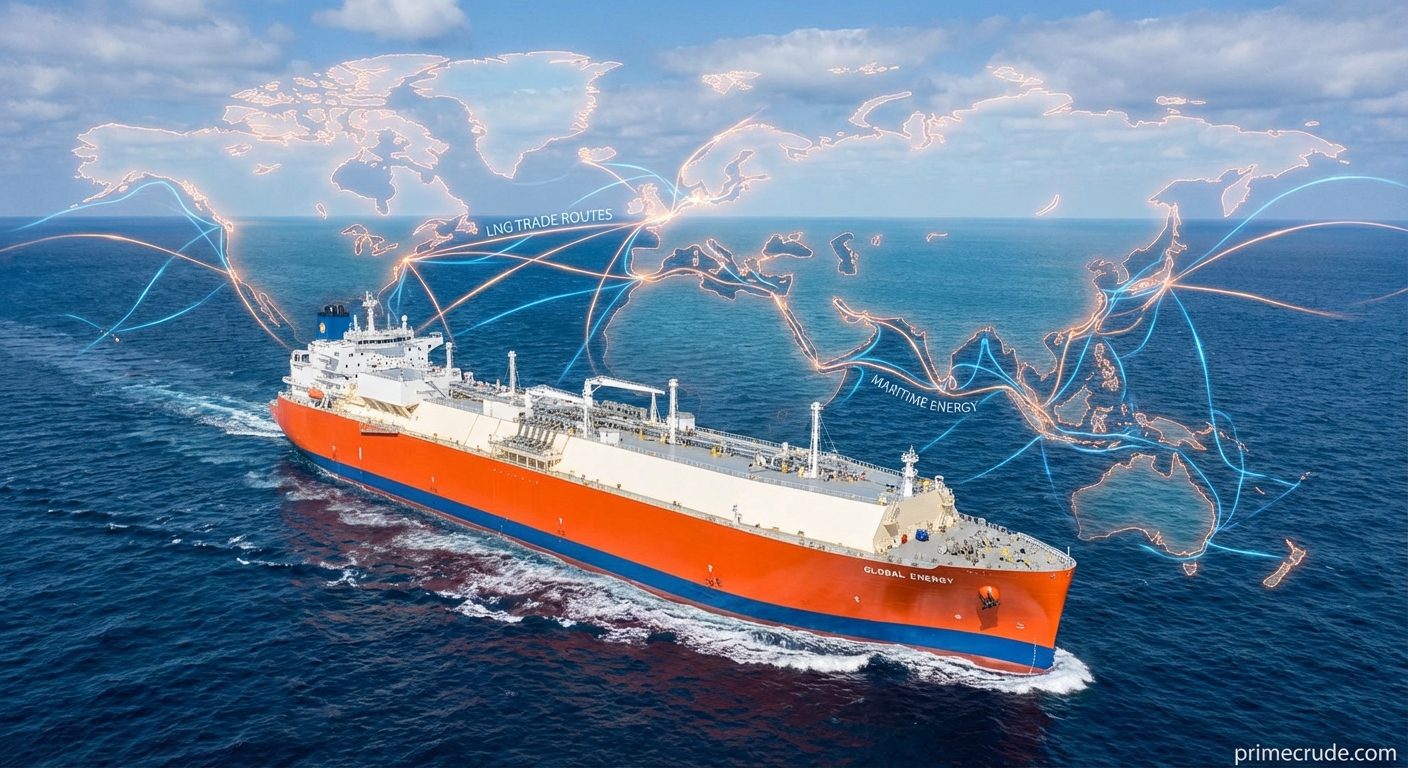
Every day, massive tankers the size of aircraft carriers glide across the world’s oceans carrying super-cooled
natural gas from distant continents to the industrial powerhouses and growing cities of Asia. This global liquefied
natural gas (LNG) trade has quietly become one of the most important supply chains on Earth, delivering the energy
that keeps factories running, homes heated, and electricity flowing for billions of people. From the chilly
production facilities of Qatar and Australia to the regasification terminals of Japan and South Korea, LNG shipping
routes trace arcs across hemispheres, navigating straits and choke points that carry geopolitical significance.
Understanding how this intricate global trade network functions reveals why natural gas prices in Tokyo respond to
weather in Texas, why shipping decisions in Singapore affect utility bills in Mumbai, and how energy security for
half of humanity depends on vessels that most people never see.
Asia’s Dependence on Imported Gas
Asia dominates global LNG demand because it lacks domestic natural gas resources relative to its enormous population
and industrial activity. Japan, the world’s largest LNG importer for decades, produces virtually no domestic gas.
South Korea imports over 99% of its natural gas. Even China, with some domestic production, imports increasing
volumes to meet explosive demand growth.
This import dependence resulted from geology and geography. Unlike the United States with its extensive shale gas
resources or Russia with vast conventional fields, most Asian nations simply lack substantial gas deposits. Their
economic growth required energy beyond what domestic resources could provide.
The Scale of Asian LNG Imports
Asian nations imported approximately 280 million tons of LNG in 2024, representing over 70% of global LNG trade.
Japan alone imports roughly 100 million tons annually—more than entire continents. China’s imports have grown from
near zero in 2000 to over 70 million tons today.
This enormous volume requires massive infrastructure at both ends of the shipping routes and hundreds of specialized
vessels continuously moving cargo. The logistics of keeping Asia supplied with gas represents one of the largest
ongoing commercial operations in maritime history.
Major LNG Exporting Nations
A handful of countries dominate LNG exports, their geographic advantages and investment decisions shaping global
trade patterns for decades after facilities are built.
Qatar holds the world’s largest proved natural gas reserves at the North Field, shared with Iran. The tiny nation
exports over 100 million tons of LNG annually, sending tankers through the Strait of Hormuz to markets worldwide.
Qatar’s central location and massive scale make it a swing supplier whose production decisions affect global prices.
Australia and the United States
Australia invested heavily in LNG facilities during the 2010s, becoming the world’s largest exporter alongside
Qatar. Most Australian LNG travels short distances to Asian markets—just 6-8 days to Japan compared to 15-20 days
from the Gulf. This geographic proximity provides logistical advantages despite higher production costs.
The United States emerged as a major LNG exporter only in the late 2010s after the shale revolution transformed the
country from import dependency to export capacity. American LNG reaches Asia via the Panama Canal or around Cape
Horn, longer voyages that become economical when price differentials justify shipping costs.
Russia’s Position
Russia exports significant LNG volumes despite sanctions on much of its energy sector. The Sakhalin-2 project serves
Asian markets from Russia’s Pacific coast. The newer Arctic LNG facilities ship via the Northern Sea Route during
summer months, creating a new trade lane that climate change is making increasingly viable.
Geopolitical tensions have complicated Russian LNG trade, with some importers avoiding Russian supplies while others
maximize purchases at discounted prices. The fluidity of these arrangements illustrates how politics intersects with
commercial considerations.
The LNG Supply Chain Explained
LNG shipping involves far more than simply loading natural gas onto ships and sailing to customers. The complex
supply chain requires specialized infrastructure at every stage.
Natural gas arriving at export facilities must be treated to remove impurities and liquids, then cooled to
approximately -260°F (-162°C) where it condenses into liquid form occupying 600 times less volume than as gas. This
liquefaction process is energy-intensive, consuming roughly 10% of the gas processed.
LNG Carrier Operations
Specialized LNG carriers maintain extreme cold throughout voyages lasting days to weeks. Most modern carriers hold
174,000 cubic meters of LNG—roughly 3.4 billion cubic feet of gas equivalent. The largest Q-Max tankers built for
Qatar carry even more.
Even with heavy insulation, some LNG evaporates during transport—”boil-off” gas that was traditionally burned as
fuel. Modern carriers often re-liquefy boil-off or use it to power ship propulsion. Cargo arriving at destination
typically has lost 0.1-0.2% per day of voyage.
Regasification Terminals
At destination ports, LNG must be warmed and converted back to gas before entering pipeline networks. Regasification
terminals receive carriers, store LNG in cryogenic tanks, and vaporize cargo on demand from pipeline operators or
power plants.
Japan has built extensive regasification infrastructure at ports nationwide, ensuring supply security through
redundancy. Floating regasification units (FSRUs)—ships that serve as offshore terminals—provide flexible import
capacity for nations seeking faster, cheaper alternatives to land-based facilities.
Critical Shipping Routes
LNG shipping concentrates on several major routes connecting export and import regions. Each route has distinct
characteristics affecting voyage time, risk, and cost.
The Middle East to East Asia route from Qatar traverses the Strait of Hormuz, crosses the Arabian Sea, passes
through the Malacca Strait (or around Singapore), and continues to Japan, Korea, or China. The 15-20 day voyage
passes through two of the world’s most critical chokepoints.
The Malacca Strait Chokepoint
The Malacca Strait between Malaysia, Singapore, and Indonesia carries roughly 25% of all seaborne trade, including
vast LNG flows to Northeast Asia. At its narrowest, the strait is only 1.7 miles wide, creating congestion and
security concerns.
Pirates historically operated in these waters, though international naval patrols have greatly reduced incidents.
More concerning for energy security, the strait could theoretically be blocked by a hostile power, motivating
Japan’s interest in supply diversification.
| Trade Route | Typical Voyage Time | Key Chokepoints |
|---|---|---|
| Qatar to Japan | 15-18 days | Strait of Hormuz, Malacca Strait |
| Australia to Japan | 6-8 days | None significant |
| US Gulf to Japan (Panama) | 20-25 days | Panama Canal |
| US Gulf to Japan (Suez) | 30-35 days | Suez Canal, Hormuz, Malacca |
| Russia (Arctic) to Asia | 15-20 days | Northern Sea Route access |
Pricing and Contracts
LNG traditionally traded under long-term contracts lasting 20 years or more, with prices linked to oil prices. This
structure provided security for both sellers financing expensive facilities and buyers ensuring supply. Asian buyers
particularly favored this model, accepting high prices for reliable supply.
The market has shifted toward shorter contracts and spot trading. Spot LNG—cargoes sold for immediate delivery—now
represents over 30% of trade, up from less than 5% two decades ago. This flexibility allows buyers to optimize
purchases but increases price volatility.
Regional Price Differences
LNG prices vary geographically, reflecting transportation costs and market conditions. The “Asian premium”
historically made Asian buyers pay more than European customers for essentially identical molecules. This premium
has narrowed as the market becomes more interconnected but hasn’t disappeared.
Price convergence between regions occurs when tankers can arbitrage differences. If Asian prices exceed European
prices by more than the cost of sailing to Asia, traders divert cargoes eastward. This arbitrage smooths price
differences and integrates previously fragmented markets.
Geopolitical Implications
Control over LNG supplies and shipping routes carries strategic significance. Energy dependency creates
vulnerability; nations that can’t fuel their economies without imports lack full sovereignty over critical policy
decisions.
Japan’s LNG dependence has shaped decades of foreign policy, from relationships with Middle Eastern gas suppliers to
infrastructure investments designed to ensure supply security. The country maintains strategic LNG stockpiles and
cultivates diverse supplier relationships.
China’s Energy Security Concerns
China’s growing LNG imports create strategic exposure that Chinese policymakers clearly recognize. The “Malacca
Dilemma”—vulnerability to supply disruption at the strait—motivates overland pipeline development, domestic
production pushes, and naval capabilities for maritime protection.
Competition between China and other Asian importers for limited LNG supplies has occasionally created tension.
During supply shortages, national interests clash as buyers bid against each other for available cargoes.
Environmental Considerations
LNG shipping’s environmental profile involves both emissions from the transportation process and broader questions
about natural gas as a transition fuel.
LNG carriers burn fuel—often LNG itself—generating CO2 emissions. Methane leakage during liquefaction, loading,
transport, and regasification adds greenhouse gas impacts. New regulations require cleaner fuels and more efficient
operations, gradually improving the industry’s footprint.
Natural Gas as Transition Fuel
Natural gas produces roughly half the CO2 of coal when burned for electricity, making it an attractive transition
fuel for coal-dependent Asian economies. LNG imports enable this coal-to-gas switching that has reduced emissions in
Japan and Korea.
However, lifecycle emissions including methane leakage may reduce natural gas’s climate advantage. The long lifespan
of LNG infrastructure—40-50 years for terminals—raises questions about consistency with net-zero emissions goals.
Future Trends in Asian LNG Trade
Several developments will shape LNG trade flows to Asia in coming decades. New supply projects are under development
in the United States, Qatar, and eventually East Africa. Demand growth in South and Southeast Asia will offset
potential declines in mature markets.
China’s domestic production increases and renewable energy expansion may slow import growth. India’s underdeveloped
gas infrastructure suggests enormous potential if policy and investment barriers are overcome. Southeast Asian
nations are both exporters and emerging importers.
New Trade Routes
Arctic shipping routes enabled by climate change could reshape LNG trade patterns. Russian Arctic LNG projects can
reach Asian markets faster via the Northern Sea Route than via traditional westward shipping during summer months.
However, extreme conditions, limited sailing windows, and geopolitical complications limit the route’s reliability.
The United States’ LNG export expansion, if projects under development are completed, would significantly increase
trans-Pacific trade. American LNG’s carbon-footprint from shale production and long-distance shipping faces
increasing scrutiny from climate-conscious importers.
Conclusion
The global LNG shipping network powering half of Asia represents one of humanity’s most impressive logistical
achievements. Massive tankers carrying super-cooled natural gas traverse oceans continuously, connecting distant
production facilities to markets that depend on imported energy for economic survival.
Understanding these trade routes illuminates connections between energy prices, geopolitical strategies, shipping
economics, and environmental considerations that affect billions of people. The countries and companies that control
LNG production and transportation wield significant economic and political influence.
As Asian economies continue growing and climate policies reshape energy systems, LNG trade will evolve but remain
critical for decades. The ships sailing invisible across the Pacific today carry fuel that lights cities, powers
factories, and shapes the destiny of nations.
The global energy trade connecting continents through LNG shipping sustains modern Asia, creating
dependencies and opportunities that will define the region’s economic and geopolitical future.
📋 Educational Disclaimer
This article is provided for educational and informational purposes only. It does not constitute financial,
investment, or professional advice. Energy markets are complex and volatile.
Before making any investment or trading decisions, consult with qualified financial advisors who understand your
specific situation and risk tolerance. Past market performance does not guarantee future results.
The information presented here is general in nature and may not be suitable for your particular circumstances.
About the Author