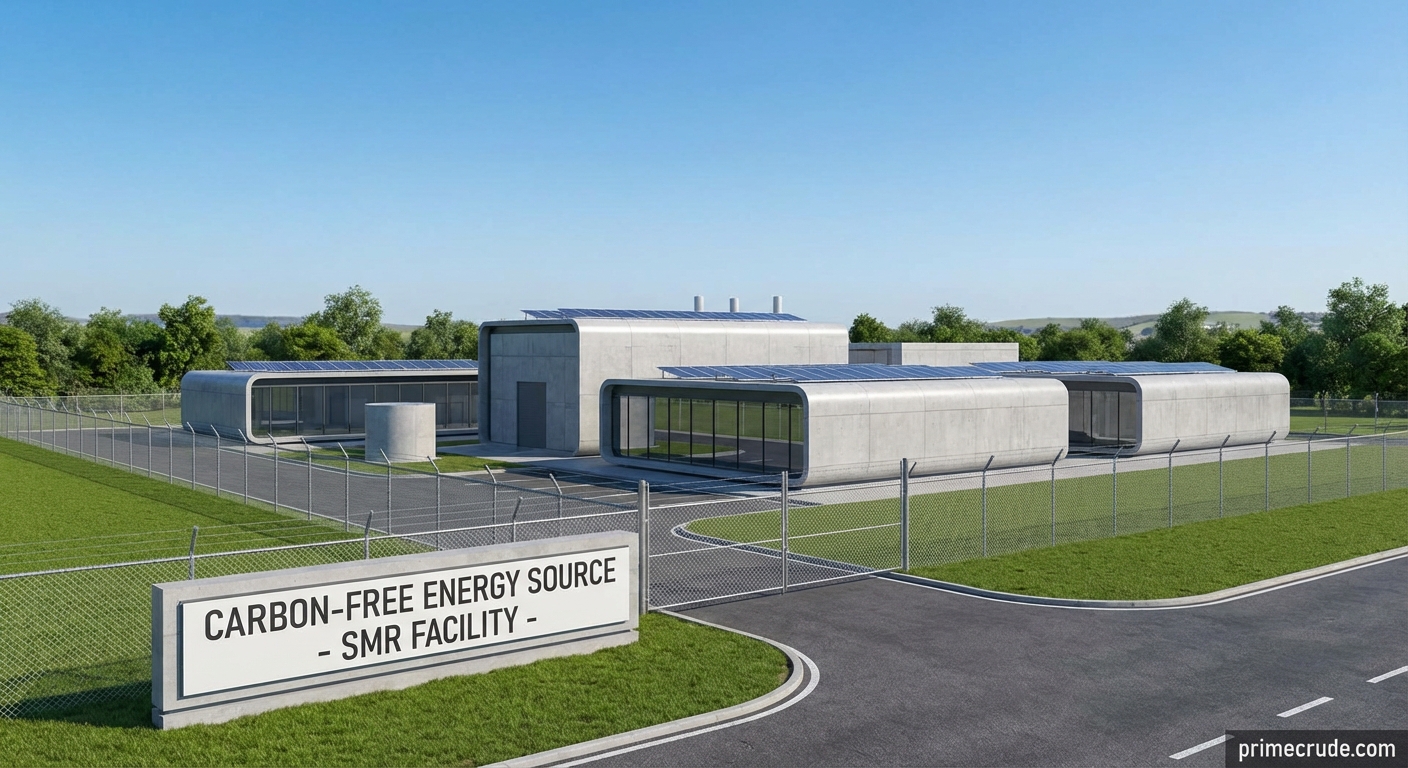
Nuclear power generates roughly 20% of American electricity with zero carbon emissions during operation, yet the
industry has declined as aging plants retire without replacement. The culprit is cost: traditional large nuclear
plants routinely exceed $20 billion and take over a decade to build, making them nearly unfinanceable in competitive
electricity markets. Small modular reactors (SMRs) promise to change this economics equation fundamentally. These
factory-built units can be transported by truck or rail, assembled on-site, and begin generating power within years
rather than decades. Their smaller size enables inherent safety features impossible in larger designs, potentially
eliminating the scenarios that led to accidents at Three Mile Island, Chernobyl, and Fukushima. Whether SMRs can
fulfill these promises will determine nuclear power’s role in a decarbonized energy future.
What Makes a Reactor “Small Modular”
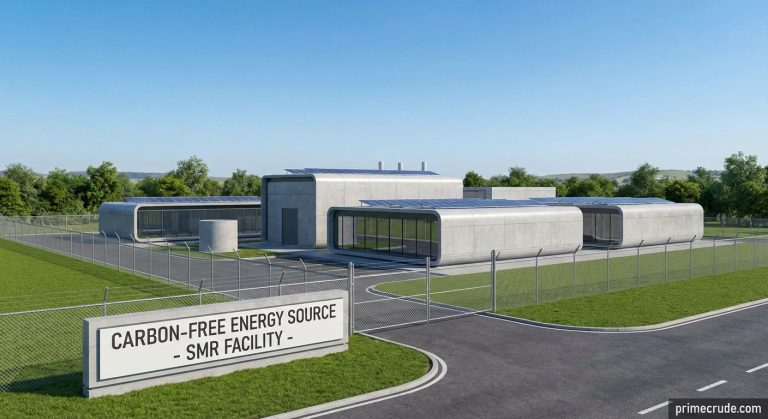
Small modular reactors are defined by power output below 300 megawatts, compared to 1,000+ MW for conventional large
reactors. This smaller size enables factory fabrication of major components, which are then shipped to sites for
assembly. The modular approach promises manufacturing efficiency impossible with custom-built large plants.
Most SMR designs use proven light-water reactor technology—the same basic physics as traditional plants—in smaller,
simplified configurations. Others explore advanced reactor concepts using different coolants like molten salt,
liquid sodium, or helium gas. Each approach offers distinct advantages and challenges.
Standardization and Factory Production
Traditional nuclear plants are essentially custom construction projects. Each reactor is designed and built largely
as a one-off, with uncertain schedules, changing requirements, and first-of-a-kind engineering challenges. This
approach maximizes cost and delay.
SMRs aim to reverse this by building reactors like manufactured products. Identical modules produced on assembly
lines should achieve learning curve cost reductions similar to other manufactured goods. The same design deployed
repeatedly avoids expensive re-engineering.
Safety Through Simplicity
Small reactor size enables passive safety features that larger reactors cannot achieve. The fundamental problem in
nuclear safety is removing decay heat after shutdown—the residual heat from radioactive decay that continues even
when the fission reaction stops. Large reactors require active cooling systems to handle this heat; if those systems
fail, as at Fukushima, meltdown can occur.
SMRs produce less decay heat and have higher surface-area-to-volume ratios, enabling natural cooling without pumps
or human intervention. Many designs are “walk-away safe”—they shut down and cool naturally even if all power is lost
and operators take no action.
Underground and Underwater Configurations
Some SMR designs place reactors underground or underwater, providing natural protection against aircraft impact,
extreme weather, or terrorist attack. The surrounding earth or water also assists with passive cooling during
emergency scenarios.
These configurations reduce the extensive security infrastructure that traditional nuclear plants require,
potentially lowering both construction and operating costs.
| Feature | Traditional Large Reactor | Small Modular Reactor |
|---|---|---|
| Power Output | 1,000-1,600 MW | 50-300 MW |
| Construction Time | 10-15+ years | 3-5 years (projected) |
| Capital Cost | $15-25+ billion | $2-6 billion (projected) |
| Safety Systems | Active (requires power) | Passive (gravity/natural circulation) |
| Manufacturing Approach | Site-built, custom | Factory-built, modular |
| Emergency Planning Zone | 10-mile radius | Site boundary (some designs) |
Leading SMR Designs
Multiple companies are developing SMR designs, each with different technological approaches and target markets. The
diversity of approaches reflects uncertainty about which designs will prove most successful.
NuScale Power’s design is the furthest advanced in U.S. licensing, having received Nuclear Regulatory Commission
design certification in 2020. The NuScale Power Module produces 77 MW per unit, with plants composed of up to 12
modules. However, NuScale’s first project was cancelled in 2023 due to cost increases, highlighting the challenges
facing the industry.
TerraPower and X-energy
TerraPower, backed by Bill Gates, is developing the Natrium reactor using liquid sodium cooling. This design
operates at higher temperatures than light-water reactors, improving efficiency and enabling integration with
thermal energy storage. The first Natrium plant is planned for Wyoming.
X-energy is developing the Xe-100, a helium-cooled, pebble-bed reactor using TRISO fuel particles that cannot melt.
This design targets industrial heat applications as well as electricity generation. Projects are planned for
Washington state and Texas.
The Economics Challenge
SMR proponents promise lower costs through manufacturing efficiency and shorter construction times. Whether these
promises will materialize remains uncertain—no SMR has yet been built at commercial scale in the United States.
The NuScale project cancellation illustrated the cost challenges. Projected electricity costs rose from $58 per
megawatt-hour to $89/MWh as development proceeded, making the project uncompetitive with alternatives. Customers
withdrew, triggering cancellation despite significant prior investment.
First-of-a-Kind Cost Penalties
Initial SMR deployments will lack the manufacturing scale and experience that promise future cost reductions. First
units will inevitably cost more than later production. Whether developers and investors can absorb these early costs
until learning curves reduce prices remains a key challenge.
Government support through loan guarantees, tax credits, and direct funding helps bridge this gap. The Inflation
Reduction Act’s nuclear production tax credit improves SMR economics significantly.
Potential Applications
SMRs may serve applications beyond grid-scale electricity generation where their characteristics provide unique
value.
Industrial heat for manufacturing, chemical production, and other processes requires high-temperature energy that
solar and wind cannot provide. SMRs could decarbonize these applications while providing reliable heat matching
industrial operating schedules.
Remote Communities and Mining
Remote communities and mining operations currently dependent on diesel generators could use SMRs for lower-cost,
cleaner power. The modular nature suits locations where construction infrastructure is limited.
Military applications for forward operating bases and naval vessels represent another potential market less
sensitive to cost considerations.
Regulatory Pathway
Nuclear regulation designed around large light-water reactors doesn’t fit SMR technology well. The NRC has worked to
develop appropriate frameworks, but licensing remains time-consuming and expensive.
NuScale’s design certification required over a decade and hundreds of millions of dollars. Streamlined pathways for
subsequent designs remain under development. The regulatory burden represents a significant cost and schedule
barrier for SMR deployment.
International Regulatory Harmonization
SMR economics depend on selling identical designs to multiple countries. Requiring separate regulatory approval in
each country would undermine manufacturing scale benefits. International efforts to harmonize SMR regulation are
underway but progress slowly.
Canada has taken a leading role in SMR regulation, with several designs under review. The UK has also established an
SMR licensing program. Coordination between these efforts and U.S. regulation could enable more efficient global
deployment.
Waste and Proliferation Concerns
SMRs produce radioactive waste requiring management like all nuclear reactors. Some advanced designs may reduce
waste volume or enable waste to be recycled as fuel, but no SMR eliminates the waste challenge entirely.
Proliferation concerns arise from spreading nuclear technology to more locations. While SMR fuel is typically less
suitable for weapons than research reactor fuel, expanding the number of facilities handling nuclear materials
creates additional security requirements.
Fuel Supply Chain
Some advanced SMR designs require high-assay low-enriched uranium (HALEU) not currently produced at commercial scale
in the United States. Building this supply chain requires significant investment and regulatory approval. Currently,
Russia is the primary HALEU supplier—a significant concern given geopolitical tensions.
Efforts to establish domestic HALEU production are underway but will take years to reach necessary scale.
Competition from Other Clean Energy
SMRs must compete not just with fossil fuels but with rapidly declining-cost solar, wind, and battery storage. Even
if SMRs achieve cost projections, they may remain more expensive than renewable alternatives for pure electricity
generation.
The case for SMRs strengthens when considering reliability, dispatchability, and industrial heat applications where
renewables face limitations. A grid with high renewable penetration may value SMRs for their ability to provide
power when the sun doesn’t shine and wind doesn’t blow.
Complementary Role
Rather than competing directly with renewables for every application, SMRs may find their role in niches where their
characteristics provide unique value. Reliability-sensitive applications, industrial heat, and geographically
constrained sites might favor nuclear despite higher costs.
This targeted deployment approach differs from the 1970s nuclear vision of powering entire societies but may
represent a viable path forward.
Global SMR Development
The United States is not alone in pursuing SMRs. Russia operates floating SMRs serving remote Arctic communities.
China is building demonstration SMRs based on multiple technologies. South Korea and other nations have active
development programs.
This global competition could accelerate or impede U.S. leadership depending on relative progress. A successful
international competitor might capture markets before U.S. designs are ready.
Export Opportunities
American SMR companies eye international markets where energy demand is growing and carbon-free generation is
valued. Export sales could provide the scale necessary to drive down costs for domestic applications as well.
However, international competition, financing challenges, and geopolitical factors affect export prospects. Russia
and China offer nuclear technology bundled with financing and fuel supply that U.S. companies may struggle to match.
Conclusion
Small modular reactors represent nuclear power’s best hope for renewed relevance in a decarbonizing energy system.
Their promise of factory manufacturing, passive safety, and reduced cost address the factors that have stalled
traditional nuclear development.
Whether SMRs can deliver on this promise remains unproven. The NuScale project cancellation demonstrates that cost
projections and commercial reality may diverge. Remaining challenges in manufacturing, regulation, and fuel supply
require solutions.
If SMRs succeed, they could provide a valuable complement to variable renewable energy, decarbonize industrial heat,
and power remote applications. If they fail, nuclear power will likely continue its slow decline as a share of
electricity generation.
Small modular reactors offer a promising path to safer, cheaper nuclear power—but only successful commercial
deployment will prove whether that promise is real or illusory.
About the Author