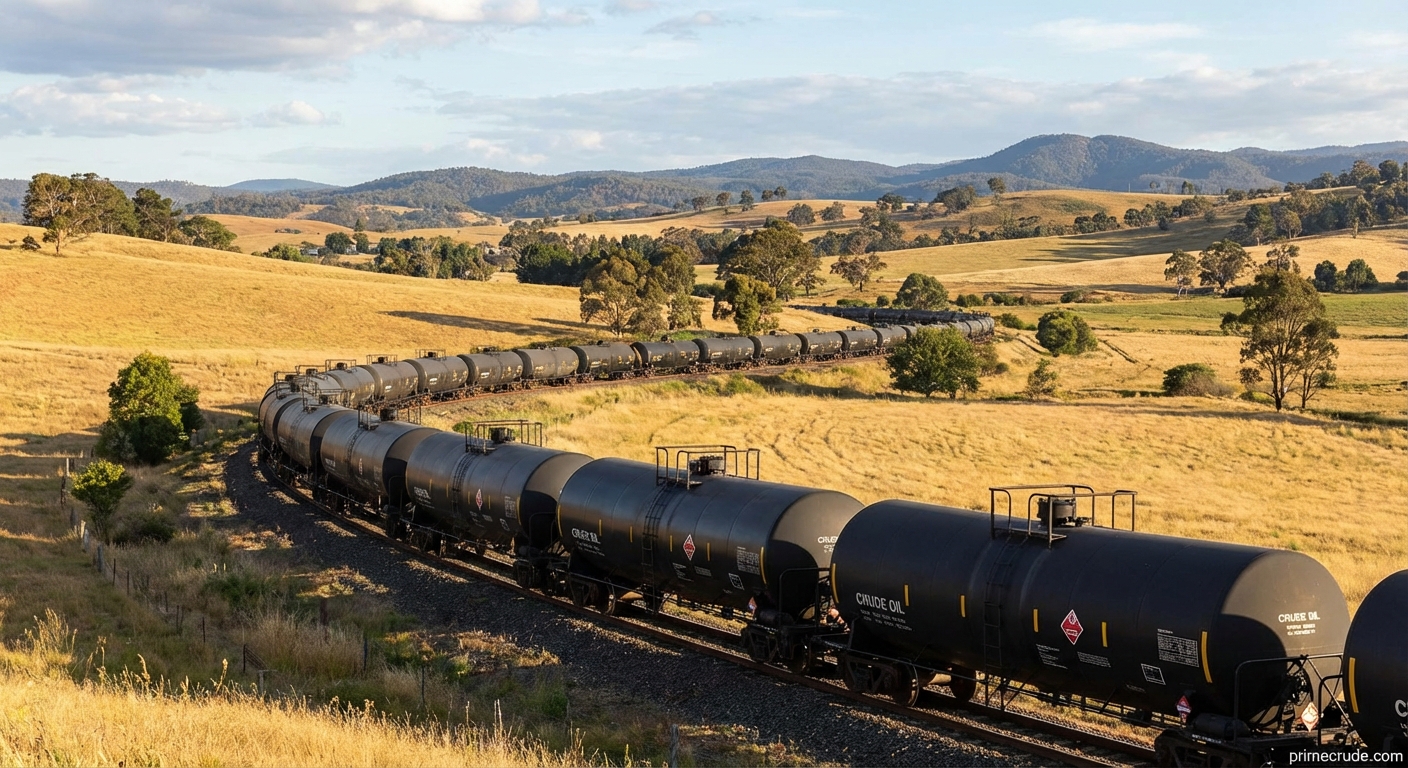
When the shale revolution unlocked oil from North Dakota’s Bakken formation faster than pipelines could be built, a
seemingly outdated solution emerged: loading crude onto rail tanker cars for transport to distant refineries.
Oil-by-rail shipments exploded from under 10,000 carloads in 2008 to over 400,000 by 2014. Rail and truck transport,
though more expensive and riskier than pipelines, provide flexibility that fixed infrastructure cannot match. When
new oil production outpaces pipeline construction, when destinations lack pipeline access, or when timing urgency
trumps cost minimization, trains and trucks move the oil. Understanding when and why these alternatives make sense
illuminates the complex logistics connecting oil production to consumption—and the trade-offs involved in choosing
between safety, cost, and flexibility.
Why Not Just Build More Pipelines?
Pipelines offer the lowest-cost transportation for high-volume, consistent oil flows. But pipelines take years to
permit and build. New production developments can begin flowing within months, creating gaps between when oil is
produced and when pipeline infrastructure catches up.
The Bakken shale boom illustrated this perfectly. Production grew from essentially zero to over 1 million barrels
daily faster than any pipeline project could have anticipated. Rail provided the flexibility to move this oil while
pipeline capacity caught up.
Opposition and Permitting Delays
Pipeline construction faces intense opposition from environmental groups, indigenous communities, and affected
landowners. Legal challenges and regulatory reviews can delay projects for years. Some proposed pipelines, like
Keystone XL, never get built despite years of effort.
Rail transport requires no new infrastructure approvals—the tracks already exist. This regulatory advantage enables
rapid response to production opportunities that fixed infrastructure cannot match.
The Economics of Rail Transport
Rail transport typically costs $10-15 per barrel compared to $2-5 for pipelines. This significant premium pencils
out only when the oil price differential to destination markets exceeds transportation costs.
During peak Bakken production, inland crude traded at steep discounts to coastal benchmarks. Rail transport to
coastal markets captured this differential, making economics work despite high costs. As pipelines caught up and
differentials narrowed, rail volumes declined.
Flexibility Value
Rail offers destination flexibility that pipelines cannot. A barrel loaded onto a railcar can go to any refinery
connected to railroad tracks—hundreds of potential destinations. Pipeline barrels go where the pipeline goes,
period.
This optionality is valuable when market conditions shift. Rail movements can quickly redirect to markets offering
the best prices. Pipeline shippers are locked into their contracted routes regardless of relative market conditions.
| Transport Mode | Cost per Barrel | Capacity Flexibility | Destination Flexibility | Safety Record |
|---|---|---|---|---|
| Pipeline | $2-5 | Fixed capacity | Fixed route | Best |
| Rail | $10-15 | Scalable | Any connected refinery | Moderate concerns |
| Truck | $15-30 | Highly scalable | Maximum flexibility | Highway accident risk |
| Barge | $3-8 | Waterway dependent | River/coastal routes | Good |
Rail Safety Concerns
Oil-by-rail safety became a major concern following a series of derailments and explosions. The Lac-Mégantic
disaster in Quebec killed 47 people when a runaway train carrying Bakken crude derailed and exploded in a downtown
area. Other incidents, while less catastrophic, raised alarms about moving flammable liquids through populated
areas.
Bakken crude was found to be particularly volatile compared to other crudes—a characteristic not initially well
understood. New regulations required “conditioning” to remove volatile light ends before rail transport, reducing
but not eliminating risks.
Enhanced Tank Car Standards
Following Lac-Mégantic and other incidents, regulators mandated safer tank car designs. The DOT-117 tank car
features thicker shells, thermal protection, and improved safety valves compared to the older DOT-111 cars involved
in major incidents.
Phase-in of new cars and retrofit of existing cars is ongoing. However, even enhanced cars cannot eliminate all
risks—trains derail, and crude oil burns. The question is whether risk reduction is sufficient, not whether risk is
eliminated.
Truck Transport for First and Last Miles
While trains move crude long distances, trucks handle the first and last miles. Tanker trucks haul crude from
wellsites to pipeline injection points or rail loading facilities. They deliver refined products from terminals to
gas stations.
Truck transport is the most expensive per barrel-mile but provides maximum flexibility. Any wellsite with road
access can connect to the system. Any gas station can receive deliveries. No infrastructure investment is required
beyond vehicles.
Short-Haul Economics
For short distances, trucks can be economical compared to alternatives. Trucking crude 50 miles to a pipeline
connection might cost $3-5 per barrel—expensive but cheaper than building a small-diameter gathering pipeline that
might never recover its costs.
The break-even distance where trucks become more expensive than pipelines depends on volume. High-volume production
justifies pipeline investment; marginal wells may never generate enough throughput to justify fixed infrastructure.
Refined Product Distribution
While crude oil increasingly moves by pipeline, refined products often require truck delivery for final
distribution. Gasoline, diesel, and jet fuel travel from refineries through product pipelines to bulk terminals,
then by tanker truck to gas stations, fuel depots, and airports.
This truck segment is unavoidable—pipelines cannot economically reach every retail outlet. The roughly 180,000 gas
stations in America each receive deliveries by tanker truck averaging every 2-3 days.
Delivery Logistics
Fuel delivery is a sophisticated logistics operation. Trucks carrying multiple compartments can deliver different
products (regular, premium, diesel) in single trips. Delivery scheduling optimizes routes and timing. Driver
shortages periodically constraint delivery capacity.
The 2021 Colonial Pipeline shutdown—from a ransomware attack rather than physical damage—highlighted how quickly
fuel runs out when delivery systems are disrupted. Panic buying emptied stations faster than trucks could resupply,
even though fuel supplies remained adequate at terminals.
Barge and Marine Transport
Barges on inland waterways provide another oil transport option where geography permits. The Mississippi River
system, Gulf Intracoastal Waterway, and other navigable waters support significant petroleum movements at costs
between pipeline and rail.
Jones Act requirements restricting domestic marine transport to U.S.-built, U.S.-flagged, U.S.-crewed vessels
increase costs but persist for national security reasons. Some policy debates question whether Jones Act reform
would reduce energy costs.
Coastal and International Shipping
Tanker ships move crude and products between coastal regions and for international trade. The dramatic growth in
U.S. crude exports relies on tanker transport from Gulf Coast export terminals to overseas customers.
Tanker costs vary dramatically with market conditions. During dislocations, shipping costs can spike from a few
dollars per barrel to $10-15 or more. Long-term charter rates are more stable but require commitment.
Infrastructure Investment Decisions
Choosing between transport modes involves complex trade-offs. Pipeline investment requires confidence in long-term
production and price differentials. Rail provides interim solutions while markets develop. Trucks handle volumes too
small or variable for fixed infrastructure.
The optimal transport mix evolves over time. Early-stage production fields may rely heavily on trucks and rail.
Maturing fields justify pipeline investment. Declining production may shift back to flexible modes as volumes no
longer support pipeline economics.
Integrated Systems
Most oil movements involve multiple transport modes. Crude might truck from wellsite to gathering pipeline, transfer
to a trunk pipeline, load onto rail cars to reach a distant market, and truck from rail terminal to refinery. Each
handoff adds cost but enables access to the best-priced markets.
Logistics optimization across modes is a specialized expertise. Midstream companies managing these movements capture
value by minimizing costs while maintaining optionality.
Environmental and Community Impacts
Each transport mode carries environmental trade-offs. Pipelines have the lowest per-barrel emissions and spill rates
but create concentrated impacts along their routes. Rail and truck transport spread impacts across entire networks
but involve more total incidents.
Communities along rail lines particularly object to crude-by-rail. The phrase “bomb trains” captures public fear
following explosive derailments. Local governments lack authority to restrict rail movements but demand federal
safety action.
Cumulative Impact Considerations
Transport infrastructure of all types has cumulative environmental justice impacts. Low-income and minority
communities often host disproportionate transport infrastructure—rail yards, truck terminals, pipeline pump
stations—bearing concentrated pollution and risk burdens.
Environmental review processes increasingly consider these cumulative impacts, though transportation projects often
face less scrutiny than production facilities.
Future Trends
Oil transport patterns will evolve with production and consumption trends. Growth in electric vehicles will
eventually reduce refined product movements. Continued shale production will maintain crude transport needs. LNG and
other alternative fuels create new transport requirements.
Hydrogen and ammonia transport for clean energy applications may use adapted versions of petroleum transport
infrastructure. Some pipeline and rail assets may repurpose for new energy commodities as oil demand evolves.
Automation and Efficiency
Autonomous trucks, if commercialized, could dramatically change short-haul transport economics. Continuous operation
without driver hours limitations increases capacity and reduces costs. Safety implications remain uncertain and
regulatory approval distant.
Improved logistics optimization through AI and data analytics is already reducing transport costs. Better route
planning, load balancing, and schedule coordination extract value from existing infrastructure.
Conclusion
Rail and truck transport provide essential flexibility when pipelines aren’t available—bridging gaps in
infrastructure, reaching markets without pipeline access, and responding to production developments faster than
fixed infrastructure can be built.
Higher costs and safety concerns make alternate transport a second choice when viable pipeline options exist. But
the flexibility value is real, and for certain applications, rail and truck will remain essential components of oil
logistics indefinitely.
Understanding why oil sometimes moves by rail or truck—rather than just pipelines—reveals the complex logistics
optimizations that keep fuel flowing from distant production fields to the gas stations where consumers fill their
tanks.
When pipelines can’t keep pace with production or reach where oil needs to go, trains and trucks fill the
gap—more expensive and riskier, but essential for a flexible energy system.
About the Author

-768x419.png)