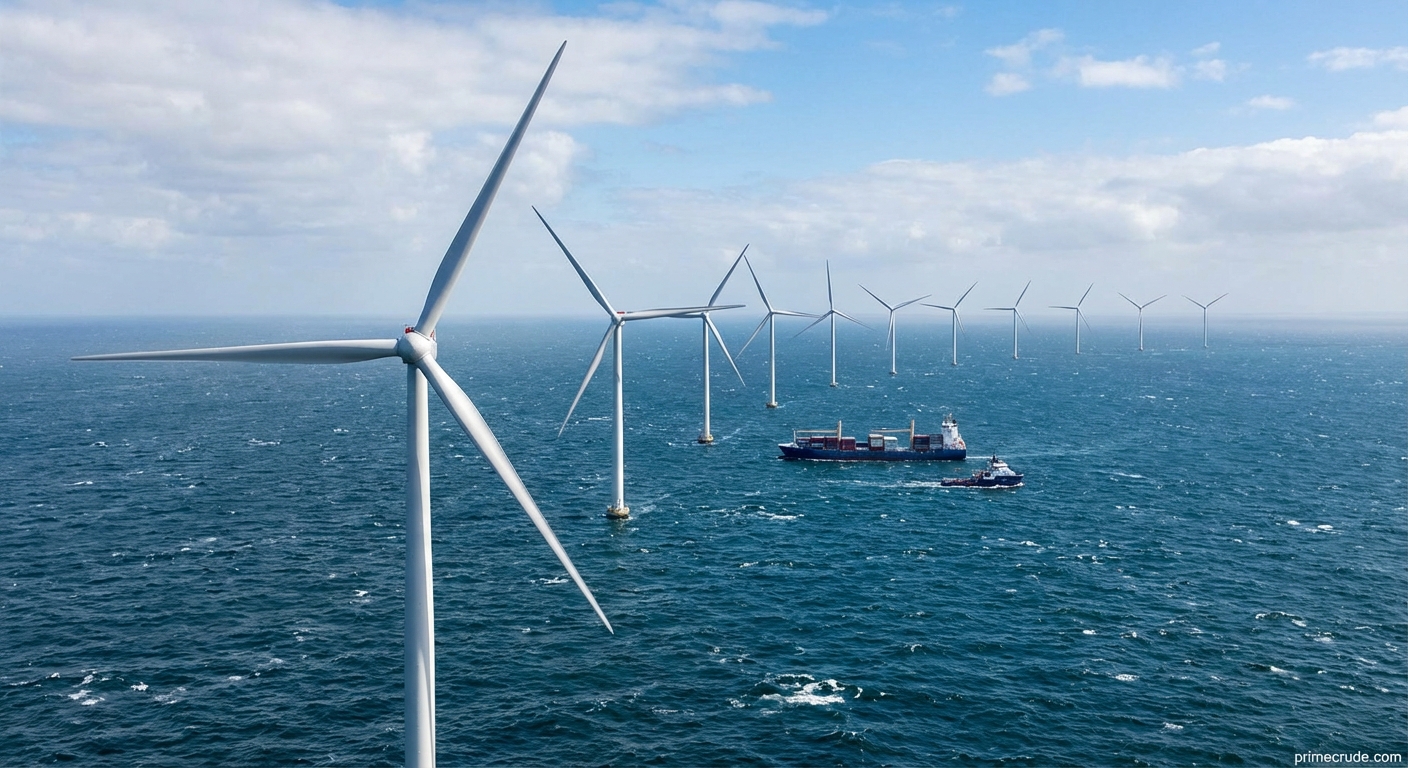
Wind turbines on the horizon have become familiar sights across many countries, their spinning blades harnessing
moving air to generate electricity. These land-based installations have driven remarkable cost reductions over the
past two decades, making onshore wind one of the cheapest electricity sources available. But the renewable energy
industry increasingly looks seaward, toward offshore wind farms that promise substantially higher energy output from
each turbine. The question of whether the premium costs of building in the ocean justify the increased production
shapes billions of dollars in investment decisions and the trajectory of renewable energy development worldwide.
Why Offshore Winds Blow Stronger and Steadier
The physics favoring offshore wind begins with basic meteorology. Land surfaces create friction that slows wind and
generates turbulence. Buildings, trees, hills, and other obstacles further disrupt airflow. The ocean, by contrast,
presents vast smooth surfaces that allow winds to build speed unimpeded.
Open ocean wind speeds average 30-50% higher than comparable onshore locations. This difference sounds modest until
you consider that wind power increases with the cube of wind speed. Double the wind speed, and power output
multiplies by eight. Even a 30% speed increase translates to roughly 2.2 times the energy from otherwise identical
turbines.
Consistency Matters as Much as Speed
Offshore winds also blow more consistently than their onshore counterparts. Land features create variable conditions
as winds eddy around obstacles and thermal effects cause daytime variations. The relatively uniform ocean surface
produces smoother, more predictable wind patterns.
Capacity factor—the percentage of theoretical maximum output a turbine actually achieves—captures this consistency
advantage. Typical onshore wind turbines achieve capacity factors of 25-35%. Offshore installations regularly exceed
40%, with the best sites pushing above 50%. This means offshore turbines generate useful electricity a much higher
percentage of the time.
The Size Advantage of Offshore Turbines
Offshore environments allow much larger turbines than onshore sites can accommodate. The biggest offshore turbines
now feature rotors exceeding 220 meters in diameter, nearly as wide as three football fields. These giants would be
impractical onshore due to transportation constraints and noise concerns.
Getting turbine components to onshore sites requires trucks navigating roads with length, width, and height
restrictions. Blades exceeding 60-70 meters create severe logistical challenges. Tower sections and nacelles face
similar constraints. These limitations cap onshore turbine size well below engineering capabilities.
Manufacturing and Deployment Flexibility
Offshore projects bypass these limitations through marine transportation. Components are manufactured at coastal
facilities and loaded onto specialized vessels. The open ocean provides unlimited clearance for oversized
components. Cranes rated for thousands of tons can install equipment impossible to handle onshore.
Larger turbines generate dramatically more electricity because swept area increases with the square of blade length.
A turbine with 110-meter blades captures four times the wind energy of one with 55-meter blades, all else equal.
Combined with stronger offshore winds, size differences explain why single offshore turbines now generate 15 MW or
more, compared to 3-5 MW for typical onshore machines.
Quantifying the Production Difference
The headline claim that offshore turbines generate three times more power than onshore machines reflects real-world
experience at many installations. Breaking down the factors:
| Factor | Typical Offshore Advantage |
|---|---|
| Higher wind speeds | 1.5-2.0x power per swept area |
| Larger turbine size | 2-4x rated capacity per unit |
| Higher capacity factor | 1.3-1.5x actual vs. rated output |
Multiplying these factors shows how a single 15 MW offshore turbine in good conditions can generate 5-10 times more
annual electricity than a 4 MW onshore turbine. Even comparing turbines of equivalent ratings, offshore
installations typically produce 40-60% more annually.
Real-World Production Comparisons
The UK’s Hornsea One offshore wind farm illustrates the potential. Its 174 turbines generate over 6 TWh annually,
equivalent to powering over a million homes. Achieving comparable output from onshore wind would require roughly
400-500 turbines spread across multiple sites.
Denmark’s experience similarly demonstrates offshore advantages. The Kriegers Flak offshore project achieves
capacity factors exceeding 45%, while the country’s mature onshore fleet averages closer to 30%. This 50% efficiency
advantage compounds over the decades-long life of wind installations.
The Cost Question: Higher Investment, Higher Output
Offshore wind’s production advantages come with substantially higher costs. Building in the ocean requires
specialized vessels, more robust foundations, and complex grid connections. Maintenance requires boats or
helicopters rather than simple truck access. These factors make offshore projects 1.5-3 times more expensive per
megawatt of installed capacity.
A typical onshore wind project in 2026 might cost $1,200-1,500 per kilowatt of capacity. Offshore projects range
from $2,500 to $4,500 per kilowatt depending on water depth, distance from shore, and local conditions. This
substantial premium explains why onshore wind developed first and remains more common.
Levelized Cost of Energy Comparison
The more meaningful metric is levelized cost of energy (LCOE), which divides total lifecycle costs by total
electricity production. This calculation accounts for offshore wind’s higher output alongside its higher costs.
Recent contracts show offshore wind achieving LCOE around $50-80 per megawatt-hour in favorable conditions. Onshore
wind achieves $25-50 per MWh in good locations. The gap has narrowed dramatically—offshore was 2-3 times more
expensive a decade ago—but onshore retains a significant cost advantage.
Cost Reduction Trajectories
Offshore wind costs have declined roughly 70% since 2012, driven by larger turbines, improved installation
techniques, and supply chain development. Further reductions are expected as the industry scales. By 2030, industry
projections suggest offshore wind could approach cost parity with new onshore installations in some markets.
However, onshore wind costs continue declining too, making it a moving target for offshore to catch. The economic
competition between the two technologies will continue evolving based on innovation in each sector.
Geographic Constraints Shape Market Development
Geographic factors determine which technology suits particular locations. Countries with long coastlines and shallow
continental shelves, like the UK, Denmark, and Germany, have embraced offshore wind. Landlocked countries obviously
can’t, while countries with less favorable coastal conditions face higher offshore costs.
The United States presents an interesting case. Vast land areas with excellent wind resources have favored onshore
development, particularly in Texas and the central plains. But Atlantic coast population centers lack nearby onshore
wind resources, making offshore development attractive for serving those markets.
Transmission and Grid Considerations
Both technologies require transmission infrastructure to connect generation to demand. Onshore wind often locates in
remote areas far from population centers, requiring long transmission lines. Offshore wind generates closer to
coastal population centers but requires submarine cables that cost more per mile.
The optimal solution varies by location. Texas’s CREZ transmission lines enabled remote onshore wind to reach urban
markets. Europe’s North Sea grid connects multiple offshore projects while serving multiple countries. Each approach
involves substantial infrastructure investment beyond the generation equipment itself.
Environmental Considerations: Different Trade-offs
Both onshore and offshore wind face environmental scrutiny, though the specific concerns differ. Neither technology
is impact-free, and understanding these trade-offs helps evaluate their overall sustainability.
Onshore wind turbines affect visual landscapes, particularly in scenic areas. Noise concerns limit how close
turbines can be sited to homes. Bird and bat mortality, while modest compared to other human impacts, raises
concerns for certain species. Land use requirements, though smaller than often assumed, compete with agriculture and
open space.
Offshore Environmental Impacts
Offshore wind creates different concerns. Construction noise during pile driving can disturb marine mammals,
requiring mitigation measures. Fishing industry displacement raises economic and social issues. Visual impacts,
while generally less contentious than onshore, still generate opposition for projects visible from shore.
However, offshore wind projects also create unexpected benefits. Turbine foundations become artificial reefs,
attracting marine life. Exclusion of fishing vessels allows fish populations to recover. Studies of operating
offshore wind farms show surprisingly rich marine ecosystems developing around foundations.
Floating Offshore Wind: The Next Frontier
Traditional offshore wind uses foundations fixed to the seabed, limiting installations to water depths under 60
meters. Floating platforms, anchored to the seabed but with turbines mounted on floating structures, overcome this
limitation. This technology opens vast deep-water areas with exceptional wind resources.
Floating offshore wind remains more expensive than fixed structures, with costs approximately 50-100% higher.
However, costs are declining rapidly as the technology matures. Several commercial-scale floating projects now
operate in Europe, with larger developments under construction.
Geographic Opportunities for Floating Wind
Floating technology could transform offshore wind markets. The U.S. West Coast, with its steep continental shelf, is
unsuitable for fixed foundations but potentially ideal for floating turbines. Japan, South Korea, and other Asian
nations with deep coastal waters gain access to offshore wind resources they couldn’t otherwise tap.
The combined addressable market for floating and fixed offshore wind exceeds that of available onshore wind sites in
many regions. This expansion of the resource base positions offshore wind for dramatically larger scale than early
skeptics anticipated.
Workforce and Supply Chain Considerations
Developing offshore wind at scale requires specialized workforce and industrial capacity. Purpose-built vessels for
turbine installation cost hundreds of millions of dollars each and take years to construct. Skilled technicians who
can work on platforms miles from shore require specialized training. Port infrastructure for component staging and
assembly needs major investment.
Countries seeking offshore wind development often establish domestic content requirements or incentives to build
local supply chains. Europe’s head start in offshore wind gives it manufacturing advantages that newer entrants work
to overcome. The U.S. has passed legislation supporting domestic offshore wind manufacturing to avoid continued
dependence on European suppliers.
Maintenance and Operations Challenges
Maintaining offshore wind farms presents ongoing challenges. Weather windows for vessel access are limited,
particularly in winter. Technicians must be trained for rope access and confined space work at heights and distances
from emergency services. The combination of marine and high-voltage electrical environments creates unique safety
requirements.
These challenges add to operating costs. Annual operations and maintenance expenses for offshore wind run 2-3 times
higher per megawatt than onshore farms. However, as a percentage of total electricity value produced, the difference
narrows given offshore’s higher output.
Policy and Market Drivers
Government policy heavily influences the relative development of onshore and offshore wind. Feed-in tariffs,
renewable portfolio standards, and competitive auctions shape which technologies get built. Countries prioritizing
offshore wind provide targeted support through seabed leasing, grid connection guarantees, and price support
mechanisms.
The U.S. has established ambitious offshore wind targets, aiming for 30 GW of capacity by 2030 and 110 GW by 2050.
European countries continue expanding their offshore fleets. China has rapidly emerged as the world’s largest
offshore wind market. These policy commitments are driving investment and cost reductions.
Auction Price Trends
Competitive auctions reveal how offshore wind economics have improved. Early projects required prices exceeding $150
per MWh to proceed. Recent auctions in the UK, Netherlands, and Germany have awarded contracts at $50-80 per MWh.
The most aggressive bids, including some requiring no guaranteed price at all, demonstrate industry confidence in
continued improvement.
However, recent inflation and supply chain pressures have caused some reversal of price declines. Several projects
awarded at aggressive prices have sought contract modifications or cancellation. The industry is adapting but faces
real cost pressures that may slow near-term deployments.
Future Outlook for Both Technologies
Both onshore and offshore wind will play substantial roles in future energy systems. Their complementary
characteristics—onshore’s lower cost versus offshore’s higher output and coastal proximity—make both valuable for
different applications.
Onshore wind will continue dominating in regions with suitable land resources and transmission access. The central
United States, parts of China, Australia, and South America offer vast potential for continued onshore expansion at
competitive costs. Technology improvements will extend economically viable sites to lower wind speed locations.
Offshore Wind’s Growing Share
Offshore wind’s share of new installations will grow substantially from its current small base. The technology is
essential for coastal regions lacking good onshore resources. As costs decline, offshore wind competes not just with
other renewables but with all power sources.
By 2040-2050, offshore wind could supply 10-15% of global electricity in scenarios with aggressive renewable
deployment. Combined with onshore wind, total wind generation could exceed 30-40% of global electricity. These
projections assume continued policy support and sustained cost improvements, neither of which is guaranteed.
Conclusion
The productivity advantage of offshore wind—often delivering three times more electricity per turbine than onshore
installations—reflects fundamental physics advantages that the ocean environment provides. Stronger winds, larger
turbines, and higher capacity factors combine to make offshore wind remarkably productive.
These productivity advantages come with higher costs that keep onshore wind economically attractive for many
applications. The choice between onshore and offshore depends on location, grid needs, available resources, and
policy environments. Both technologies will expand substantially as the world builds renewable energy capacity.
The rapid cost declines in offshore wind and the emergence of floating technology expand the addressable market for
ocean-based generation. What was once an expensive niche is becoming mainstream. Understanding the production and
cost trade-offs helps evaluate proposals and investments in this dynamic sector.
The ocean’s stronger, steadier winds and the massive turbines they can support make offshore wind a powerful
resource for electricity generation, even as higher costs maintain a role for more economical onshore
installations.
About the Author