The world’s oceans represent an immense, largely untapped energy resource. Waves roll against shorelines twenty-four
hours a day, carrying energy that could power cities. Tides rise and fall with astronomical precision, their
predictability unmatched by any other renewable source. Together, ocean wave and tidal energy could theoretically
supply a significant fraction of coastal nations’ electricity needs. Yet despite decades of development, marine
energy contributes almost nothing to global power generation. The gap between theoretical potential and practical
deployment reflects genuine technical and economic challenges that the industry is only beginning to overcome.
Understanding both the promise and the obstacles helps evaluate whether ocean energy deserves the investment and
attention that wind and solar have received. The technology may finally be approaching commercial viability after
years of expensive experiments.
The Difference Between Wave and Tidal Energy
Though often discussed together, wave and tidal energy are fundamentally different resources requiring distinct
technologies. Their characteristics, advantages, and challenges differ in important ways that affect project
development and grid integration.
Wave energy captures power from the surface motion of the ocean caused primarily by wind blowing across the water.
Waves travel thousands of miles across open ocean, accumulating energy before reaching coastlines. The amount of
energy available varies with wave height, period, and direction—factors that change continuously with weather
patterns.
Tidal Energy Fundamentals
Tidal energy harnesses the predictable rise and fall of sea levels caused by gravitational attraction between the
Earth, Moon, and Sun. Unlike waves, tides follow precise astronomical cycles known centuries in advance. This
predictability makes tidal energy particularly valuable for grid planning—operators know exactly when generation
will occur.
Tidal resources concentrate in specific geographic features. Large tidal ranges occur where topography amplifies the
tidal wave—the Bay of Fundy with 50-foot tides, the Bristol Channel, Cook Inlet, and a handful of other locations.
Tidal currents, alternatively, concentrate where water flows through narrow passages between land masses.
Wave Energy Technologies
Numerous wave energy converter (WEC) designs have been developed, with no single dominant approach emerging. This
technological diversity reflects the genuine difficulty of efficiently capturing energy from irregular ocean surface
motion while surviving punishing storms and corrosive marine environments.
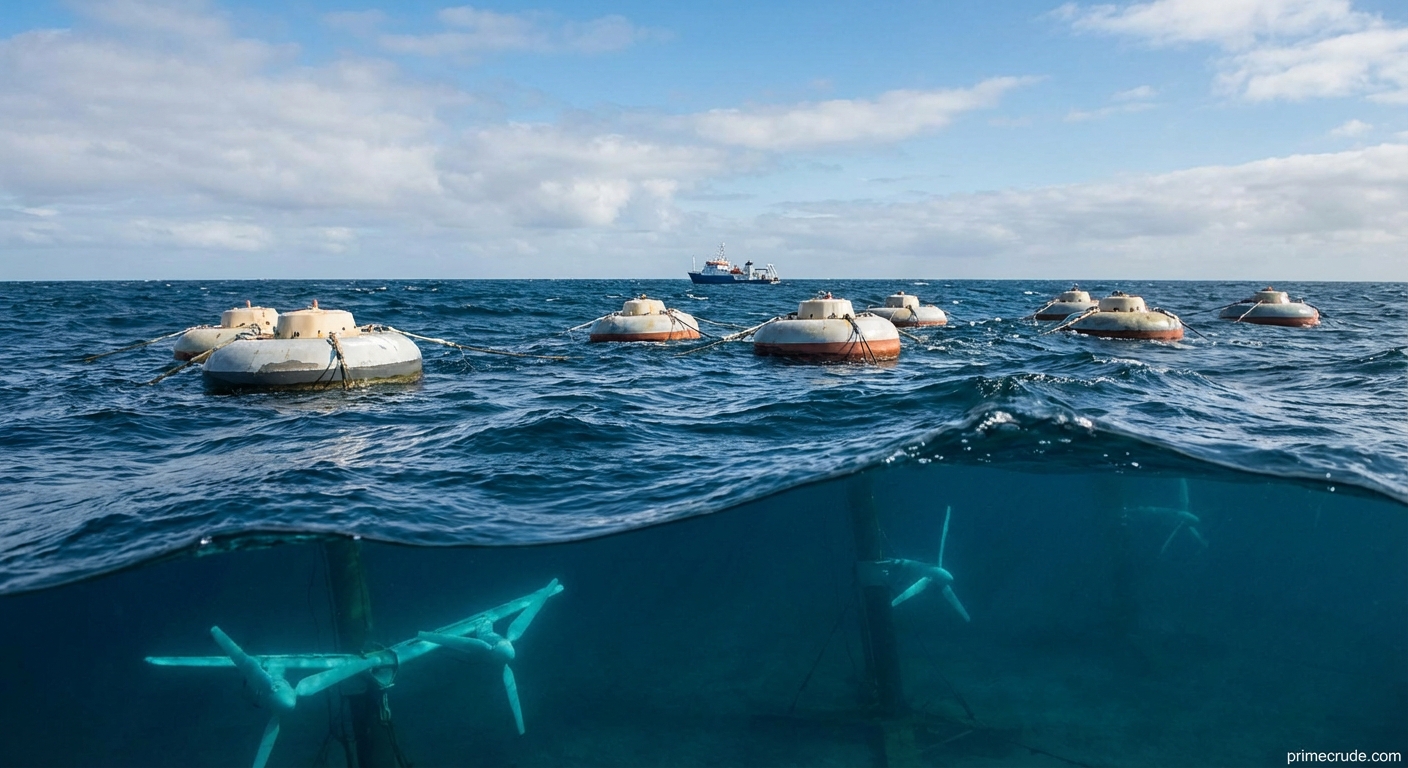
Point absorber devices bob vertically on the surface, using relative motion between floating elements and anchored
bases to drive hydraulic pumps or linear generators. These buoy-like devices can deploy in arrays across large
areas, each capturing energy from passing waves.
Attenuator and Oscillating Devices
Attenuator devices align perpendicular to incoming waves, flexing at hinges as waves pass along their length. The
Pelamis Wave Energy Converter, resembling a sea snake, demonstrated this approach before its developer’s bankruptcy.
The bending motion drives hydraulic rams that power generators.
Oscillating water column (OWC) devices capture air pressure changes as waves force water up and down in a chamber.
Air flows through a turbine that spins regardless of airflow direction. This simple principle has proven robust,
with OWC plants operating successfully for years.
Overtopping Devices
Overtopping devices capture water from waves that wash over a ramp into an elevated reservoir. The water then drains
through low-head turbines, similar to run-of-river hydroelectric plants. These structures are typically
shore-mounted, making maintenance easier than for offshore devices.
Each approach has demonstrated some success without establishing clear superiority. The industry continues testing
various concepts, seeking the combination of efficiency, survivability, and cost that makes commercial deployment
viable.
Tidal Energy Technologies
Tidal energy extraction takes two primary forms: tidal barrages that span estuaries and tidal stream turbines that
operate like underwater wind turbines. Each approach has different resource requirements, environmental impacts, and
economic profiles.
Tidal barrages create artificial lagoons by damming estuaries or bays. As tides rise and fall, water flows through
turbines in the barrage, generating electricity. The 240 MW La Rance Tidal Power Station in France, operating since
1966, demonstrates the concept works—but its construction required damming a substantial estuary with significant
environmental disruption.
Tidal Stream Turbines
Tidal stream devices extract energy from currents flowing through channels without blocking the waterway. These
turbines resemble underwater wind turbines, with rotors that spin as water flows past. Unlike wind, tidal currents
are highly predictable and concentrated in specific locations.
Several tidal stream projects now operate commercially, including MeyGen in Scotland and various projects in France
and Canada. Capacities remain small—typically 1-5 MW per turbine—but the technology has moved beyond experimental
stages to early commercial deployment.
| Feature | Wave Energy | Tidal Energy |
|---|---|---|
| Predictability | Variable (weather-dependent) | Highly predictable (astronomical) |
| Resource Availability | Widespread along coastlines | Concentrated at specific sites |
| Technology Maturity | Pre-commercial/demonstration | Early commercial |
| Capacity Factor | 25-40% | 25-35% (intermittent by nature) |
| Primary Challenge | Survivability in storms | Limited number of sites |
| Current Cost (LCOE) | $300-500+/MWh | $200-400/MWh |
The Challenge of Surviving the Ocean
The marine environment presents extraordinary challenges for any equipment. Constant salt spray corrodes metals and
degrades seals. Powerful waves stress mechanical components and moorings. Marine growth fouls surfaces and increases
drag. Lightning, impacts from floating debris, and extreme storms add to the hazards.
Wave energy devices must be robust enough to survive 100-year storms while efficient enough to extract energy from
typical wave conditions. This engineering paradox—designing for rare extreme events while optimizing for common mild
conditions—has proven difficult to solve economically.
Maintenance and Access
Accessing offshore devices for maintenance requires specialized vessels and favorable weather windows. The costs of
marine operations are multiples of land-based equivalents. Equipment that needs frequent repair becomes economically
unviable regardless of how well it performs during operation.
Tidal stream devices face additional challenges from the currents that make their locations attractive for energy
production. Installing and maintaining equipment in fast-flowing water requires carefully timed operations during
slack tide windows that may last only 30-60 minutes.
Resource Assessment and Site Selection
Identifying suitable sites requires extensive measurement campaigns to characterize wave or tidal resources. Wave
measurements must capture seasonal and annual variations that affect generation. Tidal measurements quantify flow
speeds and directions throughout the tidal cycle.
Beyond the energy resource, site selection considers seabed conditions for foundations or anchoring, distance to
electrical grid connections, shipping traffic and fishing activity, environmental sensitivities, and permitting
feasibility. The best energy resources may occur in locations challenging for other reasons.
Grid Connection Challenges
Marine energy sites often lie far from existing electrical infrastructure. Running subsea cables from offshore
devices to shore adds significant cost. Building onshore transmission to reach the grid adds further expense. These
connection costs can make otherwise promising resources uneconomic.
The intermittent nature of tidal generation—occurring twice daily with predictable timing but not necessarily
matching demand patterns—creates integration challenges. Wave energy’s weather-driven variability resembles wind
power but with lower predictability and forecastability.
Environmental Considerations
Marine energy’s environmental impacts remain less understood than those of wind and solar, which have been deployed
at much larger scales. Early evidence suggests relatively benign effects, but larger deployments may reveal
unanticipated impacts.
Tidal barrages significantly alter estuarine ecosystems by changing tidal ranges, sediment transport, and fish
migration. These impacts have constrained barrage development. Tidal stream turbines appear less disruptive, though
potential effects on marine mammals and fish navigating tidal passages require monitoring.
Potential Benefits
Marine energy structures may provide environmental benefits alongside impacts. Device foundations create artificial
reef habitat, attracting marine life. Restrictions on other activities in device arrays may create de facto
protected zones where ecosystems recover.
Displacing fossil fuel generation reduces air and water pollution and greenhouse gas emissions. These avoided
impacts represent genuine environmental benefits even if marine energy devices have some localized effects.
Current Status of the Industry
Despite decades of development, ocean energy remains a tiny contributor to global electricity generation. Total
installed capacity worldwide barely exceeds 500 MW, almost all from a handful of tidal barrages. Wave and tidal
stream technologies contribute just tens of megawatts globally.
The industry remains in a phase of demonstration projects and pilot arrays rather than commercial deployment at
scale. Several companies have demonstrated individual devices operating for extended periods. Moving from single
prototypes to cost-effective production arrays remains the central challenge.
Leading Projects and Regions
The European Marine Energy Centre (EMEC) in Scotland provides a full-scale test facility where developers prove
their technologies in real ocean conditions. Multiple wave and tidal devices have been tested at EMEC, making it the
world’s leading marine energy R&D location.
The MeyGen tidal stream project in Pentland Firth, also in Scotland, represents the industry’s most advanced
commercial deployment. With plans for up to 398 MW capacity, MeyGen would be by far the world’s largest tidal stream
installation if fully built out.
Cost Trajectory and Commercial Potential
Marine energy costs currently far exceed those of established renewables. Wave energy costs are estimated at
$300-500+ per MWh, tidal stream at $200-400 per MWh—compared to $30-50 for solar and $25-50 for onshore wind. This
cost gap explains limited deployment despite the attractive resource.
Industry advocates argue that costs will decline with deployment, following the learning curves that reduced wind
and solar costs dramatically. Wind power was similarly expensive in its early years. However, marine energy has been
under development for decades without achieving the cost reductions that wind realized.
Factors Favoring Cost Reduction
Manufacturing standardization and volume production should reduce device costs. Installation experience should lower
deployment expenses. Operations and maintenance procedures should become more efficient. Grid and port
infrastructure supporting marine energy should improve.
Realistic projections suggest marine energy could achieve costs of $100-150 per MWh with sufficient deployment—still
above current renewables but potentially competitive when marine energy’s predictability and dispatchability are
valued.
What Makes Marine Energy Valuable
Despite high costs, marine energy offers characteristics that other renewables cannot match. Tidal energy’s
predictability allows perfect forecasting days, weeks, or years in advance. Wave energy, while variable, shows
different patterns than wind and solar, providing diversification benefits.
The energy density of water—800 times denser than air—means marine devices can be much smaller than wind turbines of
equivalent capacity. This compactness could prove valuable where space is constrained.
Resource Availability
Wave energy resources are widespread along any coast with ocean exposure. Unlike tidal resources concentrated at
specific sites, wave energy could theoretically develop at numerous locations. Coastal nations with limited wind and
solar resources might find marine energy particularly valuable.
Island nations and remote coastal communities face particular energy challenges that marine energy could address.
The same geographic isolation that makes fuel imports expensive provides excellent ocean wave exposure.
Future Outlook for Marine Energy
Marine energy’s future depends on continued technology development, supportive policy and investment, and
eventually, cost reductions that make deployment economically attractive. The industry may remain small for years or
even decades before achieving competitive costs.
Climate change policies supporting all renewable technologies could help marine energy develop. Strong renewable
portfolio standards or carbon pricing that creates value for all non-fossil generation would benefit marine along
with wind and solar.
Niche Applications
Marine energy may find early success in niche applications where its unique characteristics provide particular
value. Remote island communities with high energy costs and excellent ocean resources offer potential markets.
Military installations seeking energy independence for coastal bases might value marine energy’s predictability and
dispatchability.
Desalination plants, aquaculture operations, and offshore platforms requiring local power might use marine energy
where grid connection isn’t available. These specialized applications, while limited in scale, could build the
experience needed for broader deployment.
Investment and Policy Support
Marine energy requires patient investment that accepts years of development before commercial returns. Governments
have funded substantial R&D, and some provide deployment incentives like feed-in tariffs for marine energy. Whether
this support continues long enough for the industry to reach commercial viability remains uncertain.
The UK has been the world’s leader in marine energy support, hosting leading test facilities and providing feed-in
tariffs that make early projects barely viable. Other countries with significant resources—Norway, France, South
Korea, Canada—have provided more modest support.
Private Investment Challenges
Private capital has proven difficult to attract at the scale needed for marine energy commercialization. The
combination of high technical risk, long development timelines, and uncertain cost reduction trajectories
discourages investors seeking predictable returns.
Major energy companies have shown intermittent interest, acquiring marine energy startups or investing in
development but sometimes exiting when progress proves slower than expected. The industry needs anchor investors
willing to see technology through to commercialization.
Conclusion
Ocean wave and tidal energy represent substantial untapped renewable resources with characteristics that complement
wind and solar. Tidal energy’s perfect predictability and wave energy’s widespread availability offer genuine value.
Yet decades of development have not yet produced cost-competitive commercial technologies.
The industry continues advancing through demonstration projects and early commercial deployments, primarily in the
UK and Europe. Whether marine energy achieves mainstream viability depends on continued technology development,
sustained investment, and policies that recognize its unique attributes.
For coastal nations seeking to diversify their renewable portfolios, marine energy deserves attention and continued
support. The ocean’s energy has powered fishing vessels and inspired mythology for millennia. Harnessing that power
for electricity generation remains a worthy goal, even if achieving it will take longer than early optimists hoped.
The ocean never stops moving, its waves and tides offering perpetual energy for those patient enough to
develop the technologies that can capture it safely and affordably.
About the Author