When a major power plant unexpectedly trips offline, the grid has milliseconds to respond before voltage drops and
blackouts cascade. For generations, stability came from the spinning mass of enormous turbines that resisted
frequency changes through sheer inertia. Now, warehouse-sized battery installations deliver that same
stabilization—but faster and with no emissions. Grid-scale battery storage has emerged as one of the most
transformative energy technologies of the decade, providing services that improve reliability while enabling higher
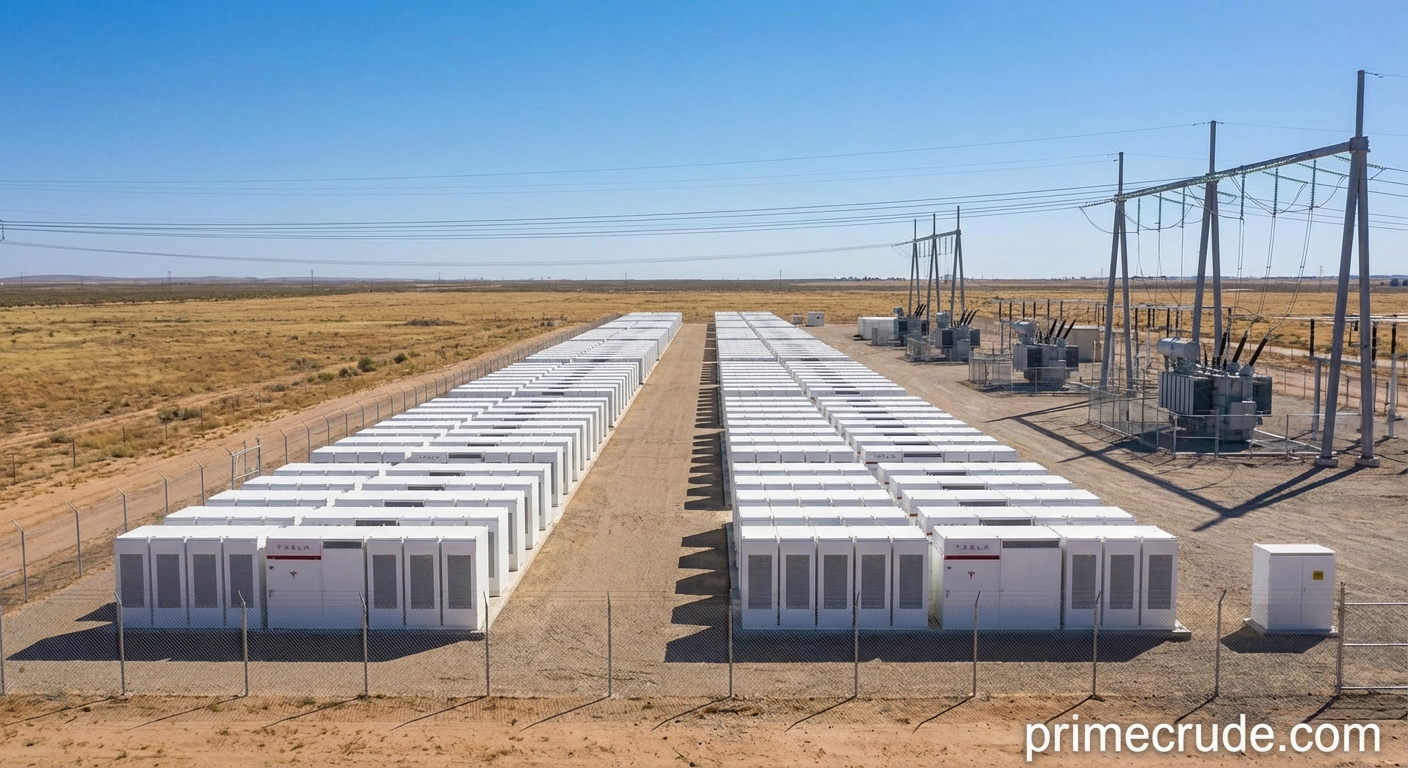
renewable energy penetration. Tesla Megapacks, Fluence systems, and other utility-scale battery products are being
deployed at unprecedented rates, fundamentally changing how the electric grid operates. Understanding what these
batteries do, where they’re being installed, and why utilities are investing billions reveals a technology reshaping
electricity infrastructure.
What Grid-Scale Batteries Do
Grid-scale batteries serve multiple functions that collectively improve grid reliability and economics. They store
electricity when abundant and cheap, releasing it when scarce and expensive. They respond in milliseconds to
frequency deviations, stabilizing the grid faster than any thermal generator. They provide backup capacity that
reduces the need for expensive peaking power plants.
Unlike home batteries primarily serving individual backup needs, grid-scale installations serve the entire
electricity system. A 100 MW battery can provide the same grid service as a 100 MW power plant—dispatched by grid
operators like any other generator, just responding much faster.
Speed Advantage
Battery response time is measured in milliseconds—essentially instantaneous compared to thermal generators that take
seconds to minutes. When a large generator trips unexpectedly, batteries can absorb the shock immediately,
maintaining frequency while slower resources catch up.
This speed advantage is particularly valuable for grids with high renewable penetration. Solar and wind variations
are faster than thermal plants can track. Batteries smooth these variations, masking intermittency from grid
operators.
Major Grid Battery Applications
Different applications drive grid battery deployment, each with distinct value propositions. Understanding these use
cases clarifies where batteries compete and where they complement other resources.
Frequency regulation—the continuous adjustment maintaining 60 Hz grid frequency—was the first major market for grid
batteries. Batteries can increase or decrease output instantaneously in response to frequency deviations,
outperforming traditional regulation resources and earning premium payments.
Peak Shaving and Arbitrage
Batteries store cheap electricity during low-demand periods and discharge during expensive peak periods, capturing
price differences. This “arbitrage” value depends on price spread between periods. Markets with large differences
between overnight and afternoon prices provide the best arbitrage opportunities.
Peak shaving reduces the highest peaks in system demand, potentially deferring transmission and distribution
upgrades that would otherwise be needed to serve growing peak load.
| Application | Typical Duration | Primary Value | Market Maturity |
|---|---|---|---|
| Frequency Regulation | 15-30 minutes | Grid stability payments | Well-established |
| Peak Shaving | 2-4 hours | Avoided peak generation costs | Growing rapidly |
| Energy Arbitrage | 2-4 hours | Price spread capture | Market-dependent |
| Renewable Firming | 1-4 hours | Enables higher renewable integration | Emerging |
| Backup/Resilience | 4+ hours | Outage avoidance | Emerging |
| Transmission Deferral | Varies | Avoided infrastructure cost | Case-by-case |
Technology and Scale
Most grid-scale batteries use lithium-ion chemistry—the same basic technology as electric vehicles and phones, but
packaged in standardized containers or purpose-built systems. Tesla Megapacks each contain about 3.9 MWh of storage;
large installations combine hundreds of units.
Individual battery installations have scaled dramatically. The Moss Landing project in California provides 400 MW /
1,600 MWh—capable of powering roughly 300,000 homes for four hours. Projects exceeding 1,000 MWh are now routine
announcements.
Alternative Technologies
While lithium-ion dominates current deployments, alternatives are emerging. Flow batteries using liquid electrolytes
offer longer duration and longer lifespan, potentially advantageous for 8-12 hour applications. Sodium-ion batteries
eliminate lithium supply chain concerns.
For very long duration storage (days to weeks), mechanical approaches like compressed air energy storage (CAES) and
gravity-based systems may prove more economical than electrochemical batteries, though few such systems have been
deployed.
Deployment Growth
Grid-scale battery deployment has accelerated rapidly. U.S. installations grew from under 1 GW total capacity in
2019 to over 15 GW by 2024. Annual additions now exceed what previously represented the entire installed base.
California leads deployment, driven by renewable energy targets, grid stress events, and favorable regulation.
Texas, with its energy-only market and volatile prices, has seen explosive battery growth capturing arbitrage
opportunities.
Global Expansion
International markets are deploying similarly rapidly. Australia pioneered grid batteries with the famous “Big
Battery” in South Australia. The UK supports significant deployment. China is installing grid batteries at enormous
scale.
Each market has different drivers—renewable integration, reliability concerns, market structures—but all are
accelerating battery deployment as costs decline and performance is proven.
Economics and Cost Trends
Battery costs have declined roughly 90% over the past decade, from over $1,000 per kWh to under $150 and still
falling. This cost trajectory has transformed batteries from experimental curiosity to mainstream grid resource.
Revenue sources for batteries are stacking. A single installation might earn money from regulation services,
arbitrage, capacity payments, and ancillary services simultaneously. This revenue stacking improves project
economics beyond any single application.
Investment and Financing
Grid battery projects attract substantial investment. Major banks finance battery installations like other
infrastructure. Tax credits available through the Inflation Reduction Act improve returns significantly—up to 50%
investment tax credit for projects meeting domestic content and other requirements.
Competition among developers is intensifying. Tesla, Fluence, BYD, and others compete for projects. This competition
drives further cost reductions and performance improvements.
Integration with Renewable Energy
Batteries and renewable energy are increasingly deployed together. Solar-plus-storage projects combine generation
and storage, providing dispatchable clean energy that can be scheduled like conventional plants.
This combination addresses the primary limitation of solar and wind—they generate only when sun shines or wind
blows. Batteries shift renewable output to match demand, enabling higher renewable penetration without grid
instability.
Replacing Peaking Plants
Natural gas “peaker” plants that run only during demand peaks are particularly vulnerable to battery competition.
Batteries can provide the same peak capacity at lower total cost while avoiding fuel costs during operation.
Some existing peaker plants are retiring early or converting to battery sites. New gas peaker construction has
largely ceased as batteries capture this market segment.
Grid Operator Experience
Grid operators are gaining operational experience managing significant battery fleets. Battery dispatch is being
integrated into energy management systems alongside conventional generators. Scheduling and dispatch procedures are
adapting to battery characteristics.
Initial concerns about battery reliability have largely been addressed. While individual battery failures occur,
system-level performance has met expectations. Degradation rates have been better than projected in many cases.
Market Design Evolution
Electricity market rules designed for thermal generators are being updated to value battery capabilities.
Fast-response ancillary service markets reward battery speed advantage. Capacity market rules are being adjusted to
recognize battery contributions.
This market design work is ongoing and contentious. How to value different duration batteries, how to account for
state-of-charge limitations, and how to ensure batteries maintain readiness for critical periods all require
answers.
Safety and Environmental Considerations
Large lithium-ion batteries present fire risks that require careful management. Thermal runaway—where one failing
cell heats adjacent cells, triggering cascading failure—can cause intense fires difficult to extinguish.
Several grid battery fires have occurred, including significant incidents at facilities in California and Australia.
While no fatalities have resulted from grid battery fires, the incidents have prompted enhanced safety requirements
and monitoring.
End-of-Life Considerations
Grid batteries have expected lifespans of 15-20 years, after which they require recycling or disposal. Lithium-ion
battery recycling infrastructure is developing but not yet at scale needed for future decommissioning volumes.
Some grid batteries may transition to second-life applications—less demanding uses after grid service—extending
useful life before recycling.
Limitations and Challenges
Despite remarkable progress, grid batteries face limitations. Duration remains constrained—most installations
provide 2-4 hours of storage, insufficient for multi-day renewable drought periods. Longer duration requires
different technologies or significantly more capacity.
Supply chain constraints have emerged as deployment accelerated. Battery cell production, particularly from limited
geographic sources, creates procurement challenges and cost volatility.
Transmission Siting
Battery value depends on location within the grid. Siting at congested transmission points or where generation is
needed provides more value than remote locations. Finding suitable sites with adequate land, transmission access,
and community acceptance can be challenging.
Permitting timelines, while generally faster than for thermal generation, still create project delays. Streamlining
permitting for battery storage remains a policy priority.
Future Outlook
Grid battery deployment is projected to continue accelerating. Forecasts suggest U.S. capacity reaching 50-100 GW by
2030—several times current levels. Longer-duration storage enabling 12+ hours will become increasingly important as
renewable penetration rises.
Battery integration into virtual power plants and distributed energy management will blur distinctions between
grid-scale and distributed storage. Aggregated home batteries may provide grid services alongside utility-scale
installations.
Evolution Beyond Lithium-Ion
As lithium-ion dominates the 2-4 hour market, alternative technologies will emerge for longer durations. Iron-air
batteries, hydrogen storage, and other approaches may address the multi-day storage needs that lithium-ion cannot
cost-effectively serve.
The grid of 2040 may include diverse storage technologies optimized for different duration needs—short-duration
batteries for frequency response, medium-duration for daily cycling, and long-duration for seasonal balancing.
Conclusion
Grid-scale battery storage has evolved from experimental technology to mainstream grid resource in less than a
decade. Tesla Megapacks and competing products are fundamentally changing how electricity grids operate—providing
faster response, enabling higher renewable penetration, and replacing older, dirtier peaking plants.
The technology is proven and economics are improving. Deployment is limited primarily by manufacturing capacity and
supply chains rather than technical or market barriers. As these constraints ease, battery deployment will
accelerate further.
The electric grid of the future will include storage as a fundamental component, as essential as generation and
transmission. Grid-scale batteries are not just storing electricity—they’re storing the reliability that makes
modern life possible.
The warehouse-sized battery systems spreading across the grid represent a fundamental shift—storing
electricity has become as important as generating it, enabling the clean energy future that seemed impossible a
decade ago.
About the Author

-768x419.png)