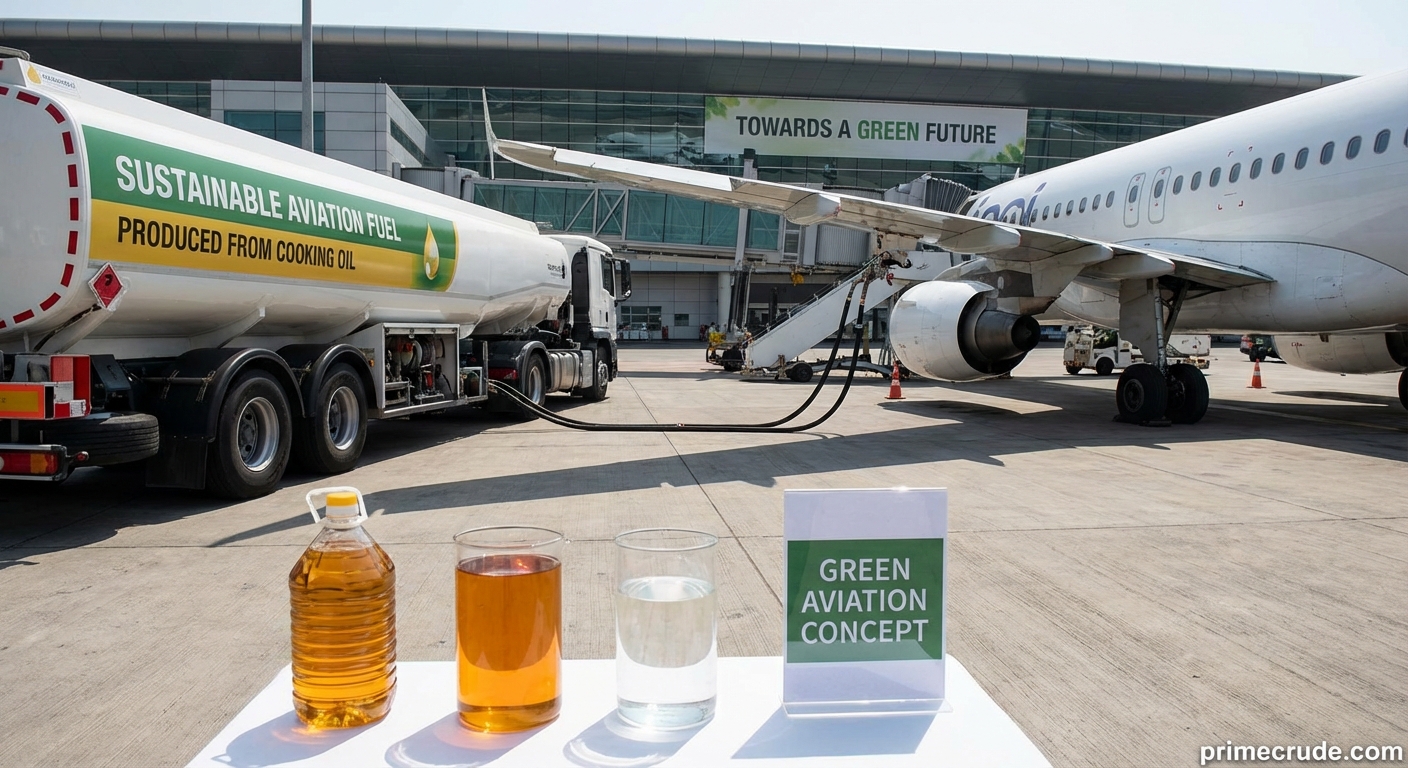
The aviation industry faces an existential climate challenge: flying generates roughly 2.5% of global carbon
emissions, and unlike cars or heating, there’s no battery or direct electrification solution foreseeable for
long-haul flights. Enter sustainable aviation fuel (SAF)—jet fuel made from waste cooking oils, agricultural
residues, and other renewable sources that can reduce lifecycle emissions by up to 80% compared to conventional jet
fuel. Airlines are placing massive orders, governments are mandating SAF adoption, and the race is on to scale
production from today’s tiny fraction of jet fuel supply to meaningful volumes by 2030. The question is whether
sustainable aviation fuel can grow fast enough to let airlines claim climate credibility or whether the industry is
betting on technology that can’t deliver at the necessary scale.
What Is Sustainable Aviation Fuel?
Sustainable aviation fuel is jet fuel produced from renewable feedstocks rather than petroleum. The resulting fuel
is chemically nearly identical to conventional jet fuel, allowing it to power existing aircraft without
modification. This “drop-in” compatibility is essential since replacing the global aircraft fleet is neither
practical nor affordable.
SAF can be produced through multiple pathways using different feedstocks. The most common current approach converts
waste fats and oils—used cooking oil, animal fats, and non-food vegetable oils—into synthetic kerosene through a
process called hydroprocessed esters and fatty acids (HEFA).
Multiple Production Pathways
Beyond HEFA, other SAF production methods are emerging. Alcohol-to-jet processes convert ethanol or other alcohols
to jet fuel. Fischer-Tropsch synthesis can gasify biomass and synthesize jet fuel from the resulting gases.
Power-to-liquid approaches use renewable electricity to produce synthetic fuels from captured CO2 and hydrogen.
Each pathway has different feedstock requirements, costs, and emission reduction profiles. The diversity of
approaches is both a strength—multiple pathways reduce risk—and a challenge, as resources are spread across
competing technologies.
How Cooking Oil Becomes Jet Fuel
The HEFA pathway—used cooking oil to jet fuel—exemplifies SAF production. Collection networks gather waste cooking
oil from restaurants, food processors, and industrial facilities. This oil is transported to refineries where
impurities are removed.
The cleaned oil is then treated with hydrogen at high temperature and pressure, breaking down fat molecules and
removing oxygen. The resulting hydrocarbon mix is processed further to meet jet fuel specifications. The final
product is indistinguishable from petroleum jet fuel in performance.
Emission Reduction Mechanism
SAF reduces emissions because the carbon dioxide released during combustion came from plants that absorbed CO2 from
the atmosphere recently—within years rather than the millions of years ago when petroleum formed. This creates a
cycle where carbon circulates rather than adding new carbon from fossil reserves.
Lifecycle analyses that account for feedstock production, transportation, and refining typically find 50-80%
emission reductions compared to petroleum jet fuel. The exact reduction depends on feedstock type and production
efficiency.
| SAF Production Pathway | Primary Feedstock | Emission Reduction | Current Readiness |
|---|---|---|---|
| HEFA | Used cooking oil, animal fats | 50-80% | Commercial scale |
| Alcohol-to-Jet | Ethanol, agricultural waste | 50-70% | Demonstration scale |
| Fischer-Tropsch | Forestry residues, MSW | 60-90% | Pilot scale |
| Power-to-Liquid | CO2, renewable hydrogen | Up to 95% | Early demonstration |
Current SAF Production and Use
Despite industry enthusiasm, SAF currently represents less than 0.1% of global jet fuel consumption. Production
capacity is expanding rapidly but from a tiny base. Total 2024 SAF production was roughly 600 million liters—a small
fraction of the 350+ billion liters of jet fuel consumed annually.
Major airports including Los Angeles, San Francisco, and Amsterdam offer SAF blending. Airlines including United,
Delta, and European carriers have made substantial purchase commitments. But the volumes remain negligible relative
to total fuel consumption.
Blending Requirements
Current regulations allow SAF to be blended up to 50% with conventional jet fuel. Most actual blends contain much
lower SAF percentages—often 2-5%—due to limited supply. Even these small percentages at major airports establish
infrastructure and experience for future scaling.
Research continues on higher blend percentages and pure SAF operation. Some test flights have used 100% SAF, though
certification for regular operations at this level remains pending.
The Feedstock Challenge
Used cooking oil is the primary feedstock for current SAF production, but the global supply of waste cooking oils
cannot support meaningful SAF volumes. Even collecting every drop of used restaurant fryer oil wouldn’t fuel more
than a small percentage of global aviation.
Competition for waste oils from biodiesel, renewable diesel, and other users further constrains SAF-available
supplies. Prices for used cooking oil have risen substantially as demand from fuel producers has grown.
Expanding Feedstock Sources
Scaling SAF beyond waste oil requires new feedstock sources. Agricultural residues—corn stover, wheat straw,
forestry waste—offer large volumes but require different conversion technologies not yet at commercial scale.
Cover crops grown between cash crop seasons could provide dedicated SAF feedstock without competing with food
production. Advanced approaches using algae, municipal waste, or direct air capture of CO2 offer future
possibilities but remain expensive and unproven at scale.
Economics and Pricing
SAF typically costs 2-4 times more than conventional jet fuel, though prices vary with feedstock costs and
production efficiency. A gallon of petroleum jet fuel costs roughly $2-3; SAF costs $5-8 or more. This premium
presents significant challenges for already thin-margin airlines.
Government incentives help bridge the gap. The U.S. Inflation Reduction Act provides tax credits up to $1.75 per
gallon for SAF meeting emission reduction thresholds. European mandates create demand that supports pricing above
conventional fuel levels.
Cost Trajectory Expectations
SAF costs are expected to decline as production scales and technology improves, but projections vary widely.
Optimistic views suggest cost parity with petroleum within 10-15 years. Pessimistic assessments doubt SAF will ever
compete without sustained subsidies.
The power-to-liquid pathway, currently most expensive, offers potential for dramatic cost reduction as renewable
electricity and electrolyzer costs fall. This pathway could eventually provide unlimited feedstock from air and
water if costs become competitive.
Airline Commitments and Mandates
Major airlines have committed to ambitious SAF adoption. United Airlines has committed to 100% green flying by 2050.
Delta has committed to net-zero emissions including SAF. European carriers face mandates requiring increasing SAF
percentages.
The International Air Transport Association (IATA) has committed the global industry to net-zero carbon emissions by
2050, with SAF playing the central role since alternatives for long-haul flight don’t exist.
EU Mandate Structure
The European Union’s ReFuelEU Aviation regulation requires SAF to comprise 2% of jet fuel in 2025, rising to 6% in
2030, 20% in 2035, and reaching 70% by 2050. Within these mandates, specific sub-quotas require synthetic fuels from
renewable electricity.
These mandates create guaranteed demand that supports investment in production capacity. However, they also risk
fuel price increases passed to passengers through higher ticket costs.
Corporate Buyer Programs
Large corporations are purchasing SAF to reduce business travel emissions. Microsoft, Boston Consulting Group, and
other companies have bought SAF through programs where they pay the premium over conventional fuel for flights their
employees take.
These book-and-claim systems let corporations fund SAF use without requiring it on their specific flights. The
company pays the SAF premium; the fuel is used somewhere in the system; the emission reduction is credited to the
payer.
Transparency and Verification
Book-and-claim systems require robust tracking to prevent double-counting emission reductions. Registry systems
track SAF production and retirement of credits. Airlines and buyers must ensure the SAF they pay for wasn’t already
counted toward other commitments.
Some critics question whether book-and-claim provides genuine environmental benefit or primarily allows corporations
to claim green credentials. Regardless, the programs channel private funding toward SAF production capacity.
Scaling Production Capacity
Meeting 2030 targets requires massive production capacity expansion. The EU mandate alone requires roughly 5 billion
liters of SAF by 2030—nearly 10 times current global production. Global industry commitments require even more.
Announced projects, if all completed, would produce perhaps 10-15 billion liters by 2030. This represents
substantial growth but remains well below the volumes needed for meaningful emission impact.
Investment Requirements
Building SAF production capacity requires billions of dollars in investment with uncertain returns. Feedstock cost
volatility, technology risk, and policy uncertainty all discourage investment. Government support through loan
guarantees, production credits, and mandates helps reduce investment risk.
Competition for capital with other clean energy investments—solar, wind, batteries, hydrogen—may constrain available
funding. SAF projects must compete for limited pools of green investment.
Technology and Innovation
Continuous innovation is improving SAF production efficiency and enabling new feedstock pathways. Enzyme research is
improving biomass processing. Catalyst development is increasing conversion yields. Process integration is reducing
energy consumption.
Breakthrough technologies could dramatically change SAF economics. Efficient direct air capture would eliminate
feedstock constraints entirely. Biological processes using engineered microorganisms might reduce production costs.
These innovations remain uncertain but could transform long-term prospects.
Synthetic Fuel Potential
Power-to-liquid synthetic fuels—e-fuels—represent the ultimate SAF solution if costs can be reduced. These fuels are
made from captured CO2 and hydrogen produced by renewable electricity electrolysis. The feedstocks are effectively
unlimited: air and water.
Current e-fuel costs are extremely high—$5-15 per liter—far above any other SAF pathway. However, costs are
dominated by renewable electricity and electrolyzer expenses that are falling rapidly. By 2040-2050, e-fuels might
become competitive.
Alternative Approaches
While SAF dominates aviation decarbonization discussions, other approaches are being pursued in parallel. Electric
aircraft are being developed for short-range flights, though battery limitations restrict them to regional routes
for the foreseeable future.
Hydrogen-powered aircraft are under development by Airbus and others, potentially entering service in the 2030s for
short-to-medium-haul routes. However, hydrogen requires new aircraft designs and fueling infrastructure.
Operational Efficiency
Airlines are improving operational efficiency to reduce fuel consumption regardless of fuel type. More efficient
aircraft, optimized routing, continuous descent approaches, and weight reduction all reduce emissions.
These improvements provide incremental benefits but cannot achieve the deep decarbonization required for climate
goals. SAF remains the primary near-term solution for long-haul aviation emissions.
Conclusion
Sustainable aviation fuel represents the aviation industry’s primary pathway toward climate compatibility. Current
production from waste cooking oils proves the technology works; the challenge is scaling production by orders of
magnitude while reducing costs and expanding feedstock sources.
The 2030 targets that airlines and governments have set will be difficult to achieve. Production capacity is growing
but likely won’t reach mandated levels. Costs remain high. Feedstock competition is intensifying.
Long-term success depends on moving beyond waste oils to agricultural residues, municipal waste, and eventually
synthetic fuels from air and renewable electricity. This transition requires continued investment, policy support,
and technology development.
The airlines turning french fry oil into jet fuel are pioneering a transformation that must expand by a
factor of 100 to let aviation claim credible climate progress—a monumental but essential challenge.
About the Author