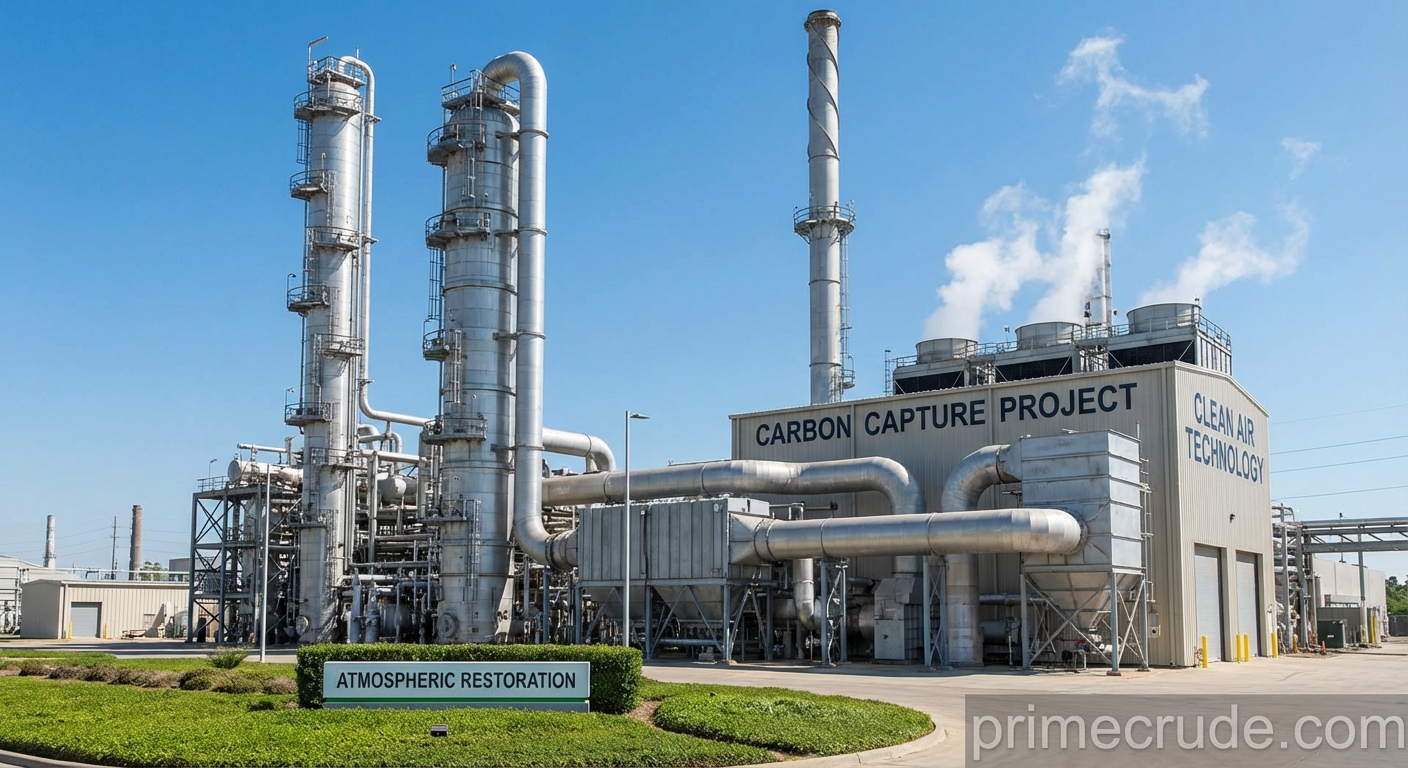
As climate change accelerates, attention increasingly focuses on technologies that might capture carbon dioxide
before it escapes into the atmosphere—or even pull existing CO2 from the air. Carbon capture and storage (CCS)
promises to let power plants, factories, and industrial facilities continue operating while preventing their
emissions from warming the planet. Some advocates describe carbon capture as essential for meeting climate goals;
critics dismiss it as an expensive distraction from renewable energy deployment. The truth, as usual, lies somewhere
between these positions. Understanding how carbon capture technologies work, what they cost, and where they’re
actually being deployed helps evaluate whether CCS deserves the billions of investment dollars flowing toward it.
The stakes extend beyond abstract climate targets to practical questions about how quickly and affordably the world
can decarbonize.
How Carbon Capture Works
Carbon capture refers to a family of technologies that separate carbon dioxide from other gases, concentrate it, and
prepare it for storage or utilization. Different approaches suit different applications, but all face the
fundamental challenge that CO2 is relatively dilute in most waste streams.
Post-combustion capture, the most common approach, removes CO2 from exhaust gases after fuel combustion. Power plant
flue gas typically contains 10-15% carbon dioxide by volume, diluted with nitrogen, water vapor, and other gases.
Chemical solvents—often amine-based solutions—selectively absorb CO2, then release it when heated.
Pre-Combustion and Oxy-Fuel Approaches
Pre-combustion capture converts fuel to hydrogen and CO2 before combustion, then separates the gases. This approach
works well in industrial hydrogen production and some power plant configurations. The concentrated CO2 stream is
easier to capture than dilute post-combustion exhaust.
Oxy-fuel combustion burns fuel in pure oxygen rather than air, producing exhaust that’s almost entirely CO2 and
water vapor. Simple condensation then separates the CO2. This approach requires an air separation unit to produce
pure oxygen, adding cost and complexity.
Direct Air Capture: The Ambitious Alternative
While conventional carbon capture targets industrial point sources, direct air capture (DAC) pulls CO2 directly from
ambient air. This approach is far more challenging because atmospheric CO2 concentration is only about 420 parts per
million—roughly 30 times more dilute than power plant exhaust.
DAC technologies use chemical processes to extract CO2 from air passing through contactors or filters. Solid sorbent
systems adsorb CO2 onto chemical surfaces, then release it when heated. Liquid solvent systems capture CO2 through
chemical reactions in solution.
Energy Requirements and Costs
Capturing CO2 from dilute sources requires significant energy—a fundamental thermodynamic reality that no technology
can fully escape. Current DAC facilities consume roughly 2,000-3,000 kWh of electricity equivalent per ton of CO2
captured, plus substantial heat energy for sorbent regeneration.
Current DAC costs range from $400-600 per ton of CO2, far above the approximately $50-100 per ton for point source
capture. Technology improvements and scale may reduce costs to $150-200 per ton by 2050, but DAC will likely remain
expensive compared to preventing emissions at source.
What Happens to Captured Carbon
Capturing CO2 is only half the challenge. The captured gas must go somewhere permanent to provide climate benefit.
Two main options exist: geological storage and utilization.
Geological storage injects CO2 deep underground into formations that can permanently contain it. Suitable reservoirs
include depleted oil and gas fields, deep saline aquifers, and certain rock formations. The CO2 is compressed to
liquid or supercritical fluid for injection.
Storage Security and Monitoring
Properly selected geological formations can store CO2 permanently. The same caprock structures that trapped oil and
gas for millions of years can contain injected CO2. Monitoring systems track injected CO2 to ensure it remains
contained.
Several large-scale storage projects have operated for decades without significant leakage. The Sleipner project in
Norway has stored over 20 million tons since 1996. However, storage site selection requires careful geological
assessment, and not all regions have suitable formations nearby.
| Storage Type | Estimated Capacity | Advantages | Challenges |
|---|---|---|---|
| Depleted Oil/Gas Fields | ~400 billion tons globally | Well-characterized geology | Existing wells may leak |
| Deep Saline Aquifers | ~10,000+ billion tons | Largest capacity | Less geological data |
| Basalt Formations | ~100+ billion tons | Mineralizes permanently | Limited locations |
| Enhanced Oil Recovery | Variable by field | Revenue from oil production | Net climate benefit debated |
Carbon Utilization Options
Rather than simply storing CO2, some approaches use captured carbon as feedstock for products. This carbon capture
and utilization (CCU) can generate revenue offsetting capture costs—but only if the carbon remains out of the
atmosphere.
Enhanced oil recovery (EOR) uses CO2 injection to push additional oil from depleted fields. This application
currently accounts for most captured CO2 consumption. However, the climate benefit is questionable since the
recovered oil will eventually be burned.
Chemical and Material Applications
CO2 can be converted to chemicals, fuels, and building materials. Synthetic fuels made from captured CO2 and
hydrogen could decarbonize aviation and shipping. CO2 can be incorporated into concrete, potentially improving
strength while permanently sequestering carbon.
However, most utilization applications eventually release the CO2 back to atmosphere when products are consumed or
decompose. Only permanent incorporation into long-lived materials—like concrete—provides lasting climate benefit
comparable to geological storage.
Major Carbon Capture Projects
Real-world carbon capture exists at significant scale, though far below what climate scenarios envision. Several
dozen facilities capture and store or utilize millions of tons of CO2 annually.
The Boundary Dam facility in Saskatchewan captures roughly 1 million tons annually from a coal power plant, storing
it in an oil field for enhanced recovery. Quest in Alberta captures CO2 from oil sands processing, storing it in
deep saline formations.
Emerging Direct Air Capture Projects
Climeworks operates the world’s largest direct air capture facility in Iceland, currently capturing about 4,000 tons
of CO2 annually and storing it in basalt formations. A much larger facility planned for construction would increase
capacity to 36,000 tons.
Carbon Engineering’s demonstration plant in Texas aims to capture 1 million tons annually when complete. Occidental
Petroleum has partnered on DAC projects designed to offset oil production emissions—a strategy requiring scrutiny
regarding net climate benefit.
The Economics of Carbon Capture
Carbon capture costs vary dramatically by application. Capturing CO2 from concentrated industrial streams costs as
little as $15-25 per ton. Power plant capture runs $50-100 per ton. Direct air capture costs $400-600 per ton.
These costs must be compared to alternatives. If an industrial facility can switch to renewable electricity for less
than the cost of capturing emissions, that approach provides better economics. Carbon capture makes most sense for
emission sources without cleaner alternatives.
Who Pays for Carbon Capture?
Without carbon pricing or subsidies, carbon capture rarely makes economic sense. Facilities capture CO2 either
because regulations require it, credits incentivize it, or enhanced oil recovery revenues justify it.
The U.S. 45Q tax credit provides $85 per ton for permanent geological storage and $60 per ton for enhanced oil
recovery. These incentives have stimulated project development, though critics argue they subsidize continued fossil
fuel use.
The Debate: Essential Tool or Dangerous Distraction?
Carbon capture’s role in climate strategy remains contentious. Proponents argue that some emissions can’t be
eliminated any other way—cement production, for example, inherently releases CO2 from limestone. Aviation and
shipping lack scalable low-carbon alternatives. Carbon capture bridges gaps that renewables cannot fill.
Critics counter that carbon capture has consistently underdelivered on promises while providing fossil fuel
industries with justification to continue operating. Investment in capture technology, they argue, would be better
spent on renewable energy that eliminates emissions in the first place.
The IPCC Perspective
Climate scenarios from the Intergovernmental Panel on Climate Change often assume substantial carbon capture
deployment, particularly for limiting warming to 1.5°C. These models show CCS as essential for rapid decarbonization
of heavy industry and, eventually, for negative emissions through bioenergy with CCS or direct air capture.
However, modeled deployment far exceeds current capacity. Scaling from millions of tons captured today to gigatons
annually within decades represents an enormous industrial challenge that many consider unrealistic.
Technical Challenges and Limitations
Beyond cost, carbon capture faces significant technical hurdles. The energy penalty—additional fuel required to
power capture systems—reduces power plant efficiency by roughly 25-30%. This means more fuel consumption and
increased local impacts even while capturing CO2.
Equipment reliability at industrial scales remains challenging. High-temperature chemical processes in corrosive
environments require robust engineering. Amine solvents degrade and need replacement. Heat exchangers and
compressors require maintenance.
Scaling Challenges
The scale of infrastructure required for meaningful climate impact is staggering. Capturing just 10% of global
emissions would require pipelines, injection wells, and monitoring systems far exceeding current fossil fuel
infrastructure. Building this capacity while still constructing renewable energy represents parallel industrial
megaprojects.
Workforce development presents another constraint. Operating carbon capture facilities requires specialized
engineering expertise. Training sufficient workers to staff thousands of facilities would take decades.
Promising Applications
Some emission sources are particularly well-suited for carbon capture where alternatives don’t exist. Identifying
these applications helps target investment where capture provides genuine value.
Cement production releases CO2 from limestone calcination regardless of energy source. Even cement plants powered
entirely by renewables would emit process CO2. Carbon capture is effectively the only way to decarbonize cement
completely.
Industrial Process Emissions
Steel production using traditional blast furnaces generates CO2 from carbon reduction of iron ore. While electric
arc furnaces avoid this when using scrap steel, primary steel production faces limited alternatives. Hydrogen-based
direct reduction offers one path; carbon capture offers another.
Chemical production, particularly ammonia synthesis for fertilizers, generates concentrated CO2 streams well-suited
for capture. Some chemical facilities already capture and sell CO2 for industrial uses.
Future Outlook
Carbon capture’s future depends on policy support, cost reductions, and competition with alternative decarbonization
approaches. Enhanced tax credits and potential carbon pricing would improve project economics. Technology
advancement should reduce costs, though fundamental thermodynamic constraints limit improvement potential.
Direct air capture, despite current high costs, offers unique value for addressing historical emissions and
offsetting hard-to-eliminate sources. If costs decline as projected, DAC could become meaningful for achieving
net-zero or net-negative emissions.
Integration with Hydrogen Economy
“Blue hydrogen”—produced from natural gas with carbon capture—may provide a transition pathway while green hydrogen
from electrolysis scales up. The CO2 captured from hydrogen production can be stored or utilized, providing
low-carbon hydrogen without requiring massive renewable electricity capacity.
Whether blue hydrogen remains a transition technology or becomes a long-term solution depends on relative costs and
the pace of renewable energy expansion.
Conclusion
Carbon capture technology works—dozens of operating facilities prove the concept at industrial scales. Whether
capture can scale sufficiently to matter for climate change while remaining economically viable remains uncertain.
For some emission sources—cement, steel, chemicals—carbon capture offers the only viable decarbonization pathway.
For power generation, capture competes with renewable alternatives that avoid emissions entirely. For
transportation, electrification and efficiency improvements are typically more cost-effective than capturing
combustion emissions.
The wisest approach treats carbon capture as one tool among many, deployed where it offers genuine advantage rather
than as an excuse to delay transition away from fossil fuels. Neither dismissing the technology entirely nor
counting on it to solve climate change reflects reality.
Carbon capture can trap CO2 before it reaches the sky—the question is whether humanity will deploy it wisely
as part of comprehensive climate action or use it to justify continued inaction.
About the Author