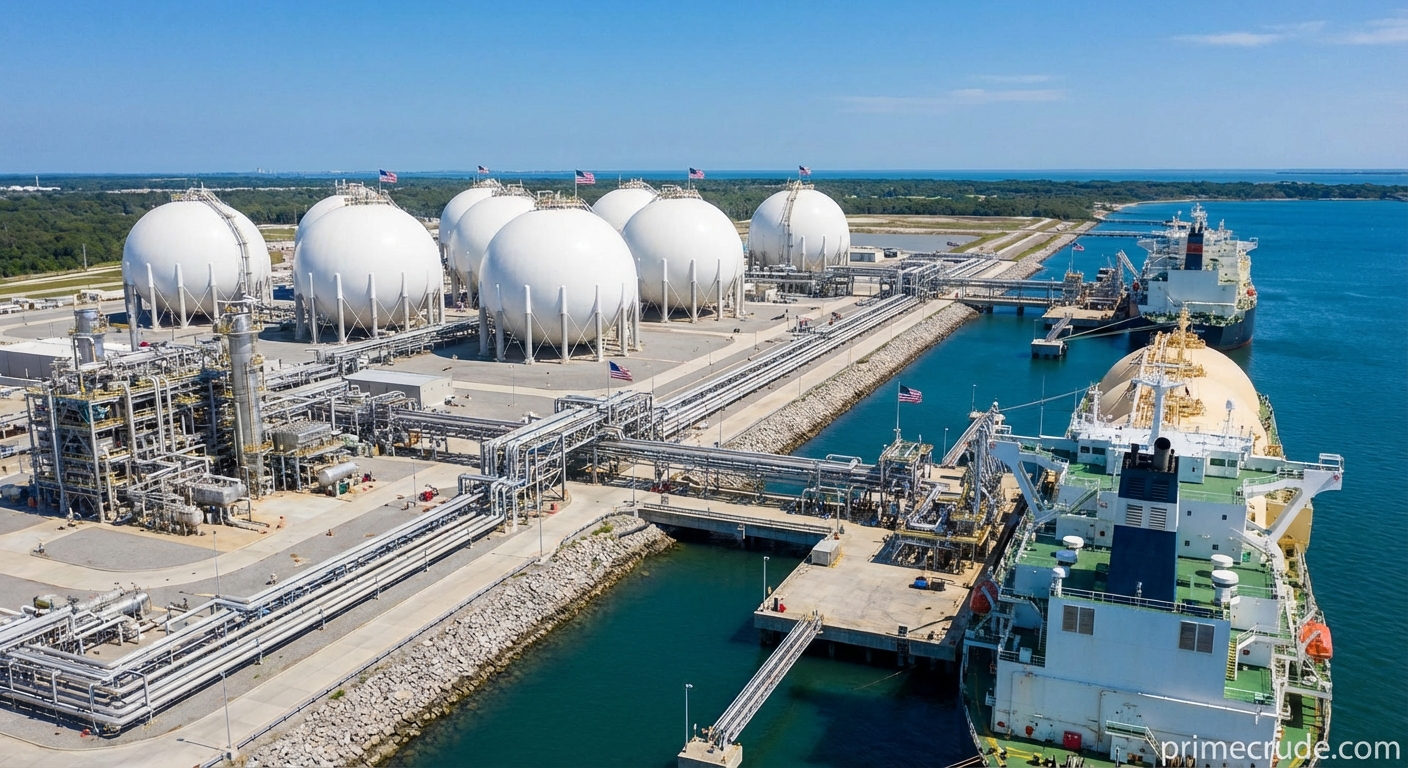
In less than a decade, the United States transformed from a natural gas importer building regasification facilities
to the world’s largest liquefied natural gas (LNG) exporter, rivaling traditional giants Qatar and Australia. This
remarkable shift resulted from the shale gas revolution producing abundant supplies and the construction of massive
export terminals that chill natural gas to minus 260°F, shrinking it to 1/600th its volume for safe ocean transport.
These facilities, representing tens of billions in investment along the Gulf Coast and increasingly elsewhere, have
reshaped global energy markets and American economic relationships. Understanding how LNG terminals work, where
they’re located, and what their expansion means for energy prices at home and abroad illuminates one of the most
significant energy developments of the 21st century.
What Is LNG?
Liquefied natural gas is simply natural gas—primarily methane—cooled to approximately minus 260°F (-162°C), the
temperature at which it condenses from gas to liquid. This phase change reduces the volume by roughly 600 times,
making oceanic transport economically viable.
Without liquefaction, transporting natural gas across oceans would be impractical. Pipelines can move gas across
continents but not across oceans. LNG enables global trade in what would otherwise be a regional commodity trapped
near its production source.
The Liquefaction Process
LNG production begins with natural gas cleanup, removing impurities like CO2, hydrogen sulfide, and moisture that
would freeze and cause problems during liquefaction. The clean gas then passes through multiple cooling stages,
typically using refrigerant cycles powered by large compressors.
Modern liquefaction “trains” can process 5-7 million tonnes per year each. Large facilities combine multiple trains
for total capacity exceeding 20 million tonnes annually. The process is energy-intensive, consuming roughly 10% of
the gas processed to power refrigeration and compression.
U.S. LNG Export Terminals
The U.S. LNG export industry emerged rapidly after the shale revolution created vast natural gas surpluses. Sabine
Pass in Louisiana shipped the first significant cargo in 2016. By 2025, U.S. export capacity exceeds 13 billion
cubic feet per day from seven operating terminals.
Additional terminals are under construction or approved, potentially doubling capacity by 2030. This expansion would
make the United States the dominant force in global LNG trade.
Major Export Facilities
Cheniere Energy’s Sabine Pass and Corpus Christi facilities are the largest, with combined capacity exceeding 6
billion cubic feet per day. Freeport LNG, Cameron LNG, and Elba Island add substantial additional capacity. Golden
Pass and other projects will come online in coming years.
Most terminals concentrate along the Gulf Coast where ample natural gas supply meets deep-water shipping access. One
facility in Maryland serves Atlantic markets; projects are proposed for the West Coast and Alaska.
| LNG Terminal | Location | Capacity (Bcf/d) | Status |
|---|---|---|---|
| Sabine Pass | Louisiana | ~4.0 | Operating (6 trains) |
| Corpus Christi | Texas | ~2.5 | Operating (3 trains) |
| Freeport LNG | Texas | ~2.0 | Operating |
| Cameron LNG | Louisiana | ~2.0 | Operating |
| Golden Pass | Texas | ~2.5 | Under construction |
How LNG Shipping Works
LNG carriers are specialized vessels with double-hulled insulated tanks designed to maintain cargo temperature
during voyages lasting weeks. Modern carriers hold 147,000-266,000 cubic meters of LNG, equivalent to roughly 3-5
billion cubic feet of natural gas when regasified.
During transport, some LNG inevitably boils off. Rather than venting this gas, most modern carriers use it as fuel,
improving economics and reducing emissions compared to traditional bunker fuel.
Global Shipping Patterns
U.S. LNG primarily flows to Europe and Asia, with shares varying based on spot prices and contract commitments.
European demand surged following Russia’s invasion of Ukraine as countries sought to reduce Russian gas dependence.
Asian markets—particularly Japan, Korea, and China—represent large, growing demand.
The Panama Canal can accommodate LNG carriers, shortening routes from the U.S. Gulf Coast to Asia. However, canal
capacity limits and fees make some voyages more economical around Cape Horn.
Economics of LNG Export
LNG export profitability depends on the “arbitrage”—the difference between U.S. gas prices plus liquefaction and
shipping costs versus destination market prices. When Asian or European prices exceed U.S. prices by $3-5 per
million BTU, exports are profitable.
Long-term contracts provide revenue certainty for terminal developers, enabling project financing. Spot market sales
offer upside when destination prices spike. Most terminals operate under hybrid models combining contracted and spot
volumes.
Impact on U.S. Gas Prices
LNG exports connect U.S. natural gas markets to global prices, potentially raising domestic prices. Pre-export,
abundant shale gas created U.S. prices far below world levels. Exports allow some price convergence.
Consumer advocates worry that exports raise heating and electricity costs for Americans. Industry proponents counter
that higher prices encourage additional production, moderating price increases while providing economic benefits.
Geopolitical Implications
U.S. LNG exports carry significant geopolitical weight. The ability to supply allies with natural gas reduces
dependence on potentially hostile suppliers like Russia. Following Russia’s 2022 invasion of Ukraine, U.S. LNG
became crucial for European energy security.
LNG exports also create economic leverage. Countries dependent on U.S. gas supplies have incentive to maintain
positive relationships. This “molecule diplomacy” represents a new dimension of American international influence.
Competition with Russia
U.S. LNG directly competes with Russian pipeline gas in Europe. Lower U.S. prices and reliable supply have captured
market share, reducing European vulnerability to Russian supply manipulation.
Russia has responded by discounting pipeline gas and developing LNG capacity of its own. This competition benefits
gas consumers while creating strategic alignment between U.S. commercial interests and European security concerns.
Environmental Considerations
LNG’s climate impact generates significant debate. Natural gas burns cleaner than coal, so replacing coal generation
with gas reduces CO2 emissions. However, the liquefaction and transport process consumes substantial energy, adding
to lifecycle emissions.
Methane leakage during production and transport compounds concerns. Methane is a potent greenhouse gas; significant
leakage could offset benefits of gas versus coal. Industry efforts focus on measuring and reducing fugitive
emissions.
Local Environmental Impacts
LNG terminal construction and operation affect local communities and environments. Industrial activity, shipping
traffic, and air emissions impact surrounding areas. Permitting processes require environmental review, though
critics argue reviews are insufficient.
Some communities welcome LNG development for jobs and tax revenue; others oppose it for environmental and safety
concerns. This tension plays out in permitting battles for new terminals.
Regulatory Framework
LNG exports require authorization from the Department of Energy and facility permits from the Federal Energy
Regulatory Commission (FERC). The review process typically takes years and involves environmental impact statements,
public comment periods, and safety reviews.
The Biden administration temporarily paused new LNG export approvals in 2024 to review climate and economic impacts.
This pause triggered industry concerns about investment certainty and geopolitical arguments about supporting
allies.
Safety Regulations
LNG facilities are subject to FERC safety requirements, Coast Guard regulations for marine operations, and
Department of Transportation pipeline rules for connecting infrastructure. The combination of extremely cold
temperatures, pressurized systems, and flammable cargo requires rigorous safety management.
Major LNG incidents are rare, and U.S. facilities have operated without significant accidents. However, the
consequences of potential incidents motivate careful regulation and facility design.
Technology Advances
LNG technology continues advancing. Floating LNG facilities (FLNG) enable production on vessels without onshore
infrastructure. Small-scale LNG projects serve niche markets uneconomical for traditional large terminals.
Modular construction approaches may reduce costs and construction time. Improved insulation and refrigeration
efficiency reduce energy consumption. Carbon capture at liquefaction plants could address climate concerns.
Integration with Renewables
Some developers propose powering liquefaction with renewable electricity rather than gas. This would reduce the
carbon footprint of LNG production, potentially creating “green LNG” that could command premium prices from
climate-conscious buyers.
Whether such projects will achieve commercial viability remains uncertain, but they represent attempts to address
LNG’s climate challenges.
Future Outlook
U.S. LNG export capacity is projected to more than double by 2030 if all permitted and under-construction projects
complete. This would make the United States the dominant global LNG supplier, reshaping energy trade patterns.
Long-term demand depends on global energy transition pace. If natural gas serves as a “bridge fuel” for decades, LNG
demand growth continues. If renewable energy and electrification advance faster than expected, LNG infrastructure
could become stranded assets.
Investment Risks
LNG terminal investments of $10-20 billion each carry significant risk given transition uncertainty. Developers and
financiers must assess whether projects will remain profitable over 20-30 year lifespans as energy markets evolve.
Some projects have already been cancelled or delayed as cost projections escalated or market conditions shifted.
Only the most competitive projects are likely to proceed in an uncertain demand environment.
Conclusion
LNG export terminals have transformed the United States from energy importer to dominant natural gas exporter in
less than a decade. This remarkable shift resulted from abundant shale gas production and massive infrastructure
investment along the Gulf Coast.
The terminals link U.S. natural gas markets to global trade, affecting both domestic prices and international energy
security. European dependence on U.S. LNG following Russia’s invasion of Ukraine demonstrated this strategic role.
The future of LNG export expansion depends on global demand trajectory, regulatory decisions, and competition with
renewable energy. What’s certain is that U.S. LNG has become a major factor in global energy markets and
geopolitics.
The massive terminals chilling gas to cryogenic temperatures for ocean transport represent America’s
emergence as an energy superpower—exporting molecules along with influence around the world.
About the Author

-768x419.png)