Just a few feet below your yard, the earth maintains a remarkably stable temperature year-round—typically between
50-60°F in most of the United States regardless of whether it’s the hottest summer day or the coldest winter night.
Geothermal heating and cooling systems tap this thermal stability, using the ground as a heat source in winter and a
heat sink in summer. The technology isn’t new—geothermal systems have been installed for over 70 years—but advances
in equipment and growing interest in energy efficiency have made it increasingly attractive. For homeowners willing
to make the upfront investment, geothermal offers heating and cooling bills reduced by 50-70% compared to
conventional systems.
How Geothermal Systems Work
Despite the name suggesting volcanic energy, residential geothermal systems don’t tap deep heat from the planet’s
core. Instead, they leverage the shallow ground’s ability to maintain constant temperature regardless of surface
conditions. The technical term—ground source heat pump—more accurately describes the technology.
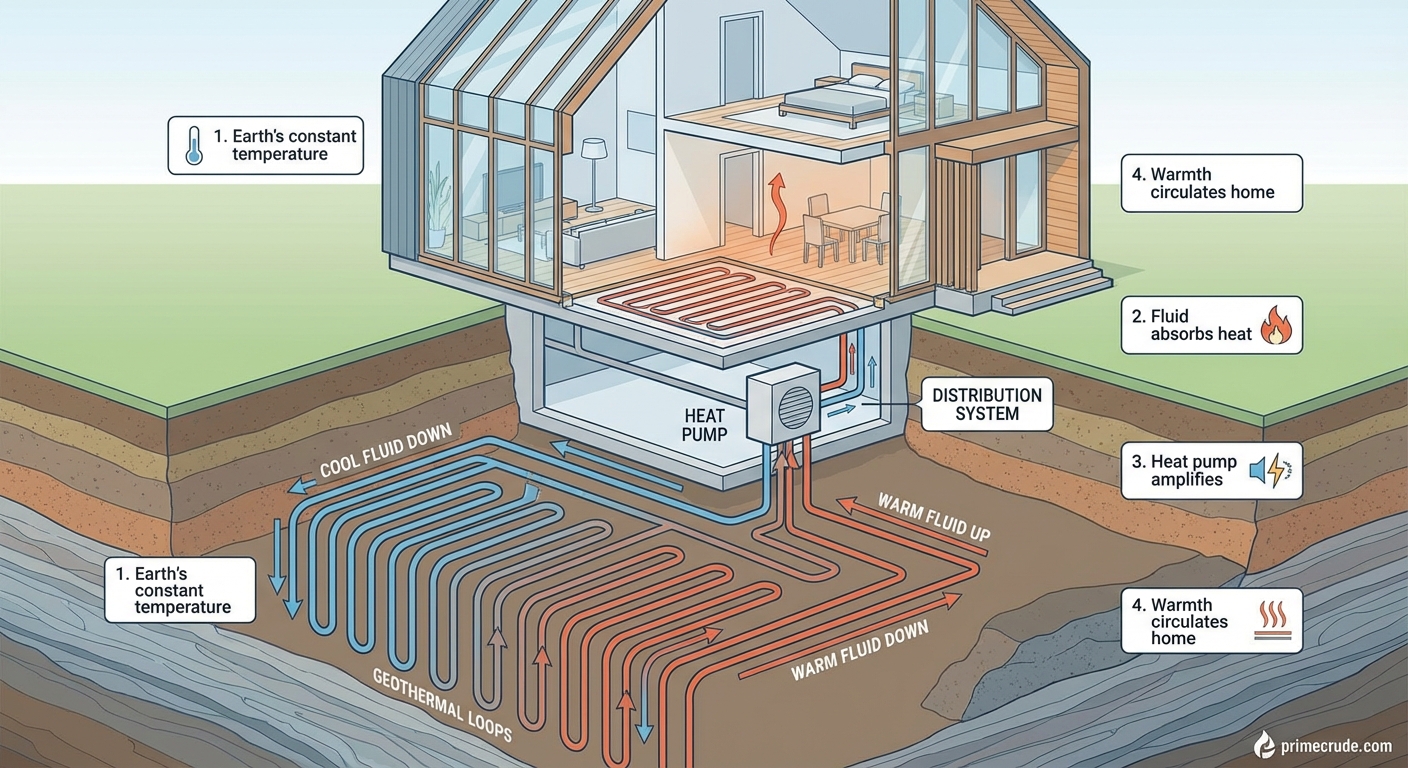
The system consists of three main components: the ground loop, the heat pump, and the distribution system. The
ground loop—pipes buried beneath your property—circulates a fluid that absorbs or releases heat to the surrounding
soil. The heat pump, located inside your home, concentrates or disperses this heat. The distribution system moves
conditioned air or water throughout your home.
Winter Heating Mode
In winter, fluid circulating through the ground loop absorbs heat from the relatively warm soil. Even at 50°F, the
ground contains useful heat energy. The heat pump compresses this low-grade heat to temperatures sufficient for home
heating—the same principle as a refrigerator running in reverse.
This process proves remarkably efficient because the heat pump moves existing heat rather than creating it. For
every unit of electricity consumed, a geothermal system delivers 3-5 units of heat energy. This efficiency ratio,
expressed as a Coefficient of Performance (COP), far exceeds conventional heating equipment.
Summer Cooling Mode
In summer, the process reverses. The heat pump extracts heat from inside your home and transfers it to the ground
loop fluid. This heat then dissipates into the cooler soil. The ground, consistently cooler than summer air
temperatures, readily absorbs the excess heat.
This rejection of heat to the ground is more efficient than conventional air conditioners, which must reject heat to
hot outdoor air. On a 95°F day, an air conditioner must work against that high temperature. A geothermal system
works against 55°F ground temperature—a much easier task.
Ground Loop Options
The ground loop represents the largest and most distinctive component of a geothermal system. Several configurations
suit different properties and conditions. The optimal choice depends on available land, soil conditions, and local
climate.
Horizontal loops spread pipes through trenches at depths of 4-6 feet. This approach requires substantial land
area—typically 1,500-3,000 square feet per ton of heating/cooling capacity—but installation costs less than
alternatives. Properties with ample open space often find horizontal loops most economical.
Vertical Loop Systems
Vertical loops use deep boreholes—typically 100-400 feet deep—with pipes installed vertically rather than
horizontally. This configuration requires minimal surface area, making it suitable for smaller lots or developed
properties where trenching isn’t practical.
Drilling costs make vertical systems more expensive than horizontal installations. However, the reduced land
disturbance and suitability for constrained sites often justify the premium. Urban and suburban homes frequently use
vertical loops.
Pond and Lake Systems
Properties with access to ponds, lakes, or large streams can use water as the heat exchange medium. Loops are
submerged in the water body rather than buried in soil. Water’s excellent thermal properties make these systems
particularly efficient.
Pond/lake systems require water bodies of sufficient size and depth—typically at least 8 feet deep and 1/2 acre per
ton of capacity. Regulatory permissions may be required for installations in natural water bodies as opposed to
private ponds.
Cost Breakdown and Payback Periods
Geothermal systems cost substantially more to install than conventional heating and cooling equipment. Total
installed costs typically range from $20,000 to $40,000 for an average home, compared to $10,000-15,000 for a
high-efficiency furnace and air conditioner combination.
The ground loop accounts for most of the cost difference. Drilling or excavation, pipe materials, and
labor-intensive installation drive expenses. The indoor heat pump equipment costs modestly more than conventional
units but isn’t the primary cost factor.
Operating Cost Savings
High efficiency translates to low operating costs. Homeowners typically see 50-70% reduction in heating and cooling
expenses compared to conventional systems. In climate zones with high heating or cooling loads, annual savings of
$1,500-3,000 are common.
Simple payback calculations divide incremental cost by annual savings. A $25,000 premium generating $2,000 annual
savings implies 12.5 years payback. However, this simple math ignores electricity price increases over time and the
system’s 25+ year lifespan.
Federal and State Incentives
Federal tax credits significantly improve geothermal economics. The current 30% federal tax credit reduces effective
cost by nearly one-third. A $35,000 installation generates a $10,500 tax credit, dropping net cost to $24,500.
Many states and utilities offer additional incentives. Rebates, performance-based payments, and property tax
exemptions vary widely by location but can further reduce effective costs. Checking available incentives before
installation helps optimize project economics.
Installation Considerations
Installing a geothermal system involves more complexity than conventional HVAC equipment. Proper design, quality
installation, and appropriate site assessment are essential for achieving expected performance.
Site assessment should include evaluation of soil conditions and thermal properties. Different soils conduct heat
differently, affecting loop sizing. Sandy, dry soils provide poorer heat transfer than clay or moist soils. A
qualified installer will consider local conditions when designing the system.
Choosing an Installer
Geothermal installation requires specialized expertise beyond typical HVAC work. Look for contractors certified by
the International Ground Source Heat Pump Association (IGSHPA) or with substantial geothermal-specific experience.
General HVAC contractors may lack the knowledge for proper geothermal installation.
Request references from previous geothermal customers and inquire about system performance after several years of
operation. A well-designed and installed system should deliver consistent performance for decades; poorly executed
projects may underperform or require expensive corrections.
Home Integration
Geothermal systems integrate with various distribution systems. Forced-air ductwork, radiant floor heating, or fan
coil units can all work with ground source heat pumps. Existing ductwork often serves geothermal installations in
retrofits, though upgrades may improve performance.
Hot water generation represents an attractive bonus. Most geothermal systems can provide domestic hot water as a
byproduct of heating and cooling operation. A “desuperheater” captures excess heat that would otherwise be wasted
and uses it to preheat water heater supply.
Climate Considerations
Geothermal systems work in virtually any climate, but economic attractiveness varies with local conditions. The
technology proves most compelling where both heating and cooling loads are substantial and conventional energy costs
are high.
Cold climate regions see excellent geothermal performance because ground temperatures remain well above air
temperatures throughout winter. A system working against 50°F ground is far more efficient than air-source equipment
struggling against sub-zero air.
Hot Climate Effectiveness
In hot climates, ground temperatures may be warmer than cold regions but still substantially cooler than summer air.
A ground temperature of 65°F provides efficient cooling even when air temperatures exceed 100°F.
Mild climates with minimal heating or cooling needs may not justify geothermal’s upfront premium. The savings
potential is simply lower when baseline energy consumption is modest.
Maintenance and Lifespan
Geothermal systems offer exceptional longevity and low maintenance requirements. The ground loop, with no moving
parts, typically lasts 50+ years—essentially the life of the home. The indoor heat pump unit lasts 20-25 years,
roughly double the lifespan of conventional furnaces and air conditioners.
Maintenance requirements are minimal. Annual inspections similar to conventional HVAC equipment, occasional filter
changes, and periodic system checks constitute typical maintenance. There’s no outdoor condenser unit exposed to
weather, eliminating that maintenance category.
Reliability Advantages
With most components located indoors and no exposure to extreme weather, geothermal systems experience fewer
failures than conventional equipment. The compressor—the most complex component—operates under favorable conditions
with smaller temperature differentials, reducing wear.
When repairs are needed, they’re typically simpler than outdoor unit issues. Component access in a basement or
utility room beats servicing equipment in harsh weather.
Environmental Benefits
Geothermal heating and cooling offers significant environmental advantages. The elimination of on-site combustion
eliminates local emissions. High efficiency reduces electricity demand, and the electricity used increasingly comes
from renewable sources as grids decarbonize.
Compared to typical heating systems, geothermal reduces carbon emissions by 40-70% even with current electricity
grid carbon intensity. In regions with clean electricity, reductions approach 90%. As grids add more renewable
power, geothermal systems become cleaner without any equipment changes.
No Refrigerant Risks
Geothermal systems typically use water or water-antifreeze mixtures in their ground loops, avoiding ozone-depleting
or high-global-warming-potential refrigerants in the outdoor component. The heat pump uses refrigerant internally,
but in smaller quantities than conventional air conditioners.
This characteristic simplifies end-of-life disposal and eliminates risks of refrigerant leaks degrading system
performance or harming the environment.
Is Geothermal Right for Your Home?
Determining whether geothermal makes sense for your situation requires evaluating multiple factors. Site
suitability, energy costs, incentives, and personal priorities all influence the decision.
Favorable indicators include high current heating/cooling costs, available land for ground loops, access to federal
and state incentives, and plans to remain in the home long enough to recoup investment. New construction
particularly favors geothermal because ground loop installation integrates with other site work.
When to Consider Alternatives
Geothermal may not suit every situation. Extremely rocky soil can make ground loop installation impractical or
prohibitively expensive. Small urban lots may lack space for any loop configuration. Short ownership horizons limit
payback opportunity.
Air-source heat pumps have improved dramatically and now offer compelling performance at lower cost than geothermal.
In moderate climates, modern air-source equipment may deliver similar efficiency at significantly lower upfront
investment. Cold climate air-source heat pumps have closed much of the performance gap that previously favored
geothermal in harsh winters.
Getting Started
Homeowners interested in geothermal should start with energy assessment. Understanding current heating and cooling
consumption establishes the savings baseline. Inefficient homes may benefit more from insulation and air sealing
before investing in new HVAC equipment.
Contacting multiple geothermal installers for site assessments and quotes provides cost estimates and identifies any
site-specific challenges. Quality installers will perform load calculations and design systems appropriately sized
for your home’s needs.
Financing Options
Various financing options address geothermal’s upfront cost barrier. Home equity loans, PACE (Property Assessed
Clean Energy) financing, and utility programs offer paths to geothermal for homeowners without cash on hand for full
upfront payment.
When financing, compare total cost of ownership including interest against alternatives. The impressive operating
savings may still justify borrowing costs, but the analysis should reflect actual financing terms rather than cash
purchase scenarios.
Conclusion
Geothermal heating and cooling systems tap the earth’s stable subsurface temperature to provide exceptionally
efficient climate control. Energy savings of 50-70% compared to conventional systems translate to meaningful annual
cost reductions. Long equipment life and minimal maintenance extend the value proposition.
The technology isn’t for everyone. High upfront costs, site requirements, and the availability of increasingly
capable air-source alternatives make geothermal a choice that requires careful analysis. For homeowners with
suitable properties, long ownership horizons, and high energy costs, geothermal often proves an excellent
investment.
The earth beneath your feet contains free, renewable energy waiting to be tapped. Geothermal systems provide a
proven, mature technology for accessing this resource while reducing energy costs and environmental impact.
For homeowners seeking the most efficient heating and cooling available, geothermal technology delivers
decades of savings by harvesting the stable energy stored just beneath the surface.
About the Author