Every year, farms across America generate millions of tons of agricultural waste—corn stover, rice husks, wheat
straw, orchard prunings—that often becomes a disposal problem rather than a resource. Meanwhile, forests produce
countless tons of residue from logging operations and wildfire prevention activities. Biomass energy facilities
transform these organic materials into electricity and heat, solving waste management challenges while generating
renewable power. Unlike solar and wind, biomass provides dispatchable generation that runs when needed regardless of
weather conditions. Understanding how this technology works, its advantages and limitations, and where it fits in
the renewable energy landscape helps evaluate its role in both farm economics and community energy supply. The
technology isn’t new, but modern advances have dramatically improved efficiency and reduced emissions.
What Qualifies as Biomass?
Biomass encompasses any organic material derived from plants or animals that can be used for energy production. This
broad definition includes agricultural residues, forestry byproducts, dedicated energy crops, food processing waste,
animal manure, and municipal organic waste. Each feedstock has distinct characteristics affecting its energy
content, handling requirements, and environmental footprint.
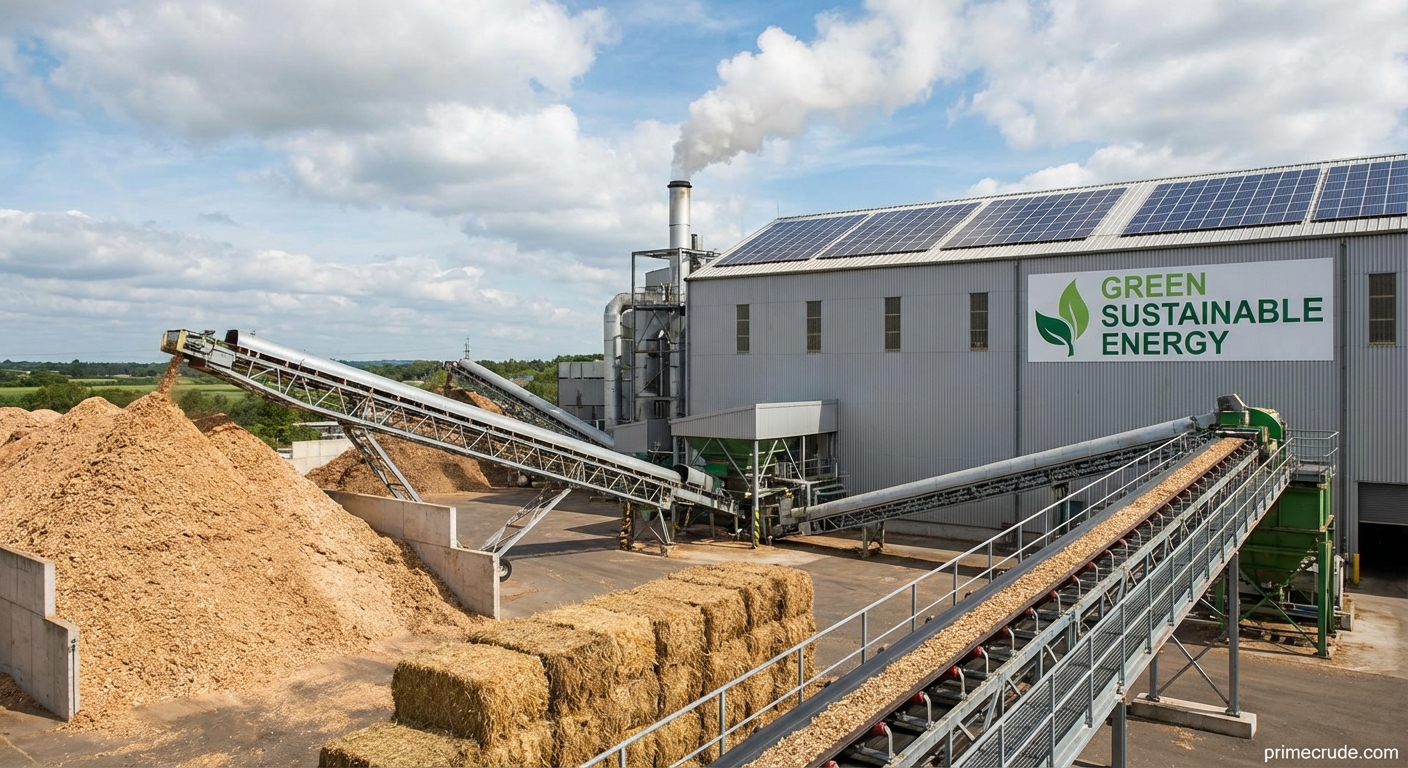
Agricultural residues represent one of the largest and most accessible biomass categories. After grain harvest,
enormous quantities of stalks, leaves, and cobs remain in fields. Cotton gins produce seeds, hulls, and fiber waste.
Fruit and nut orchards generate prunings and culls. These materials, if not utilized, require disposal and may
become fire hazards or decompose and release greenhouse gases.
Forest Residues and Wood Waste
Forestry operations produce substantial biomass as a byproduct. Logging leaves behind branches, treetops, and
unmarketable small-diameter wood. Sawmills generate sawdust, bark, and wood chips. Forest management activities,
including the treated forest material from wildfire prevention, create additional feedstocks.
Wood waste from construction and demolition, pallets, and urban tree trimming adds to the potential fuel supply.
These materials would otherwise occupy landfill space or require costly disposal.
Dedicated Energy Crops
Some biomass comes from crops grown specifically for energy production. Switchgrass, miscanthus, and short-rotation
woody crops like willow and poplar can produce high yields on marginal land unsuitable for food production. These
purpose-grown feedstocks offer consistent quality and year-round availability that agricultural residues may lack.
Energy crop cultivation remains limited in the United States, with most biomass facilities relying on residue and
waste feedstocks. However, dedicated crops may expand as the industry matures and demand grows.
How Biomass Becomes Electricity
Converting biomass to electricity typically involves combustion—burning the material to produce heat that generates
steam, which drives turbines connected to generators. This straightforward approach resembles conventional fossil
fuel power plants, with biomass substituting for coal or natural gas as the heat source.
Direct combustion facilities feed processed biomass into boilers where controlled burning releases heat energy.
Water circulating through tubes in the boiler walls absorbs this heat and becomes high-pressure steam. The steam
expands through turbines that spin generators, producing electricity. Exhaust steam condenses back to water and
recirculates.
Gasification Technology
Gasification offers an alternative to direct combustion. Rather than burning biomass completely, gasification heats
it in a controlled low-oxygen environment to produce combustible gases—primarily carbon monoxide, hydrogen, and
methane. This “syngas” can fuel internal combustion engines, gas turbines, or combined cycle plants.
Gasification offers higher efficiency than direct combustion for smaller-scale applications and produces cleaner
exhaust. However, the technology is more complex and remains less common than conventional combustion.
Anaerobic Digestion
Wet biomass like animal manure and food waste is better suited to anaerobic digestion than combustion.
Microorganisms break down organic material in oxygen-free tanks, producing biogas—primarily methane and carbon
dioxide. This biogas can generate electricity on-site or be upgraded to pipeline-quality natural gas.
Dairy farms, wastewater treatment plants, and food processing facilities increasingly use anaerobic digesters. The
technology handles materials too wet for burning while producing valuable fertilizer as a byproduct.
Scale and Distribution of Biomass Power
Biomass power plants range from small farm-scale units generating a few hundred kilowatts to large utility-scale
facilities exceeding 100 MW. The appropriate scale depends on feedstock availability, transportation economics, and
local energy needs.
Transportation costs fundamentally limit biomass facility size. Unlike coal or natural gas, which travel
economically over long distances, bulky biomass becomes prohibitively expensive to haul more than 50-75 miles. This
constraint typically limits biomass plants to 25-75 MW capacity, small by utility standards but significant for
rural communities.
Geographic Distribution
Biomass power facilities cluster in regions with abundant feedstocks. California, with intensive agriculture and
forestry, hosts numerous biomass plants. The Southeast, with extensive forest products industry, has significant
capacity. Upper Midwest states generate power from corn and soybean residues.
Total U.S. biomass power capacity exceeds 15,000 MW, though actual generation varies with feedstock availability and
market conditions. Biomass provided roughly 1% of U.S. electricity in 2024, a small but meaningful contribution.
Environmental Profile of Biomass Energy
Biomass energy’s environmental credentials generate significant debate. Proponents emphasize its renewable nature
and waste utilization benefits. Critics point to stack emissions and question carbon neutrality claims. The reality
is nuanced and depends heavily on specific feedstocks and practices.
The carbon neutrality argument holds that biomass combustion releases only carbon that plants absorbed during
growth, creating a closed cycle with no net atmospheric addition. This contrasts with fossil fuels, which release
ancient carbon that had been locked away for millions of years.
Emissions Considerations
Biomass combustion does produce pollutants requiring control. Particulate matter, nitrogen oxides, and carbon
monoxide emissions require sophisticated control equipment to meet air quality standards. Modern biomass plants
invest heavily in emission controls that early facilities lacked.
The lifecycle carbon footprint depends on feedstock source. Waste materials that would decompose anyway represent
clear carbon benefits. Harvest of residues that would otherwise remain in fields has more complex implications for
soil carbon. Dedicated energy crops may displace other land uses with their own carbon effects.
Comparison with Fossil Fuels
| Factor | Biomass Power | Coal Power | Natural Gas |
|---|---|---|---|
| Carbon Source | Recently atmospheric | Fossil/ancient | Fossil/ancient |
| Net CO2 Addition | Near zero (if sustainably sourced) | High (>2,000 lbs/MWh) | Moderate (~850 lbs/MWh) |
| Particulate Emissions | Moderate (with controls) | High (requires controls) | Very low |
| Waste Utilization | Converts waste to energy | Creates ash waste | No solid waste |
| Fuel Renewability | Annually renewable | Non-renewable | Non-renewable |
Economic Factors in Biomass Power
Biomass electricity typically costs more to produce than wind or solar, limiting its competitiveness in pure energy
markets. However, biomass provides value that variable renewables cannot—dispatchable generation available on
demand, not just when the sun shines or wind blows.
Feedstock costs represent the largest operating expense, typically 40-60% of total costs. These costs vary
dramatically with local conditions. Facilities co-located with processing operations receiving waste feedstock enjoy
significant advantages over those purchasing and transporting materials.
Revenue Streams and Incentives
Biomass plants may earn revenue from multiple sources beyond electricity sales. Waste disposal fees provide income
when facilities accept materials that generators would otherwise pay to dispose of. Renewable energy credits in
states with portfolio standards add value. Heat sales for industrial processes or district heating create additional
income.
Federal tax credits for renewable energy have historically included biomass, though specific provisions vary with
legislation. State incentives vary widely, with some states providing substantial support and others offering
little.
Benefits for Rural Communities
Biomass energy provides economic benefits to rural areas where feedstocks originate. Power plants employ local
workers for operations, maintenance, and feedstock handling. Farmers and forest landowners receive income from
selling materials that might otherwise have no value. The money spent on fuel stays in the local economy rather than
flowing to distant coal mines or gas fields.
Agricultural diversification reduces farm income volatility. Farmers with contracts to supply biomass facilities
gain a stable revenue stream independent of commodity price swings for their primary crops.
Waste Management Solutions
For many agricultural and forestry operations, biomass energy solves waste disposal problems. Open burning of
agricultural residues, once common, now violates air quality regulations in many areas. Disposal costs for wood
waste and other materials have increased. Energy facilities that accept these materials provide valuable service
regardless of the electricity they generate.
Wildfire prevention creates particularly urgent need for biomass utilization. Forest management activities generate
enormous volumes of material that must be disposed of safely. Without energy markets, this material often
accumulates as fire hazard or requires expensive disposal.
Challenges Facing the Industry
Despite its benefits, biomass power faces significant challenges that have caused some facilities to close and
limited new development. Competition from cheaper solar and wind, volatile feedstock markets, and policy uncertainty
all create difficulties.
The dramatic cost decline in solar and wind power has challenged biomass economics. A biomass plant costing $150-200
per megawatt-hour cannot compete with solar at $30-50 per MWh for undifferentiated energy. Biomass must emphasize
its unique attributes—dispatchability, waste utilization, rural benefits—to justify premium costs.
Feedstock Supply Challenges
Reliable feedstock supply at stable prices proves difficult to maintain over facility lifetimes of 20-30 years.
Agricultural practices change. Forest ownership patterns shift. Competing uses for biomass materials—livestock
bedding, mulch, erosion control—may offer higher prices during supply shortages.
Weather and regional factors also affect availability. Drought reduces agricultural residue production. Wet harvests
make material collection difficult. Wildfires can simultaneously create urgent need for biomass markets while
consuming potential feedstocks.
Advanced Biomass Technologies
Emerging technologies may improve biomass energy economics and environmental performance. Torrefaction pre-treats
biomass to create a more energy-dense, easily handled fuel. Pyrolysis produces bio-oil that substitutes for
petroleum fuels. Integrated biorefineries produce both energy and valuable chemicals from biomass.
Combined heat and power (CHP) configurations significantly improve overall efficiency. Rather than rejecting heat to
the environment after generating electricity, CHP systems capture this heat for industrial processes or building
heating. Overall fuel utilization can exceed 80%, compared to 30-35% for electricity-only plants.
Carbon Capture Potential
Biomass with carbon capture and storage (BECCS) offers a pathway to negative carbon emissions—actually removing CO2
from the atmosphere. By capturing the carbon dioxide from biomass combustion and injecting it underground, the net
effect removes carbon that plants absorbed from the air.
Climate scenarios limiting warming to 1.5°C often assume large-scale BECCS deployment later this century. While the
technology remains unproven at scale, biomass’s potential for negative emissions gives it unique value in deep
decarbonization strategies.
International Perspectives
Biomass energy plays varying roles around the world. European countries, particularly in Scandinavia and the UK,
utilize biomass extensively for both electricity and heating. The Drax Power Station in the UK converted from coal
to biomass, becoming one of the world’s largest biomass facilities.
Developing countries often rely on traditional biomass—wood and charcoal—for cooking and heating, generally with
poor efficiency and significant health impacts. Modern biomass energy systems represent a dramatic improvement over
these traditional uses while preserving biomass’s role in energy supply.
Sustainability Certification
Concerns about unsustainable biomass sourcing, particularly for international trade, have led to certification
systems. Programs like the Sustainable Biomass Partnership verify that biomass feedstocks meet environmental and
social standards. These certifications provide assurance to buyers and regulators that biomass delivers claimed
environmental benefits.
Certification requirements add costs but help distinguish responsibly sourced biomass from potentially problematic
supplies. As the industry matures, certification is becoming a standard expectation.
Future Outlook for Biomass Energy
Biomass energy’s future likely lies in niches where its unique characteristics provide value rather than
head-to-head competition with low-cost variable renewables. Waste utilization, dispatchable generation, and rural
economic development all provide differentiated value propositions.
The growth of variable solar and wind actually increases the value of dispatchable resources that can fill gaps.
Biomass may find expanding market opportunity providing reliability services even as its share of total generation
remains modest.
Integration with Other Renewables
Hybrid facilities combining biomass with solar, storage, or other technologies may offer compelling economics. A
solar installation backed by biomass generation could provide firm power around the clock, capturing both solar’s
low cost and biomass’s reliability.
Policy support recognizing biomass’s unique attributes—particularly its ability to utilize waste materials and
provide dispatchable renewable generation—would help the industry navigate competition from declining-cost
alternatives.
Conclusion
Biomass energy production offers a pathway to convert agricultural waste, forest residues, and other organic
materials into valuable electricity and heat. The technology provides benefits that extend beyond clean energy to
include waste management solutions, rural economic development, and dispatchable generation that complements
variable solar and wind.
Challenges remain in feedstock supply, economics, and emissions management. Biomass isn’t suitable for all locations
or as the foundation of entire energy systems. But in the right applications, it provides genuine value that other
renewable technologies cannot replicate.
Agricultural communities with waste disposal needs, regions with forestry residues requiring utilization, and areas
seeking locally-sourced renewable energy may find biomass an attractive option. Understanding its strengths and
limitations helps identify appropriate applications.
Biomass energy transforms waste into power, rural challenges into opportunities, and organic materials into
clean electricity—a renewable resource hiding in plain sight.
About the Author