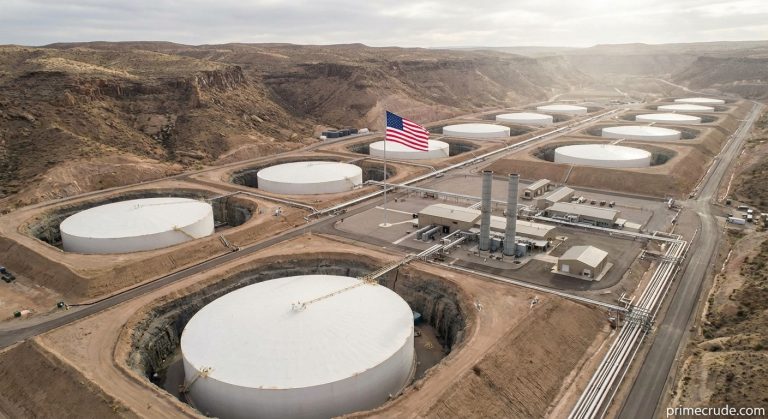
Underneath the farms, forests, and highways of North America runs an invisible network of steel arteries carrying
the lifeblood of modern civilization. Major oil pipelines, some stretching thousands of miles, connect landlocked
oil fields to coastal refineries and export terminals. These infrastructure projects, often costing billions of
dollars and taking years to complete, determine which oil gets to market and at what cost. Understanding the major
pipeline systems explains why crude oil prices vary by region, why pipeline disputes become political flashpoints,
and how energy infrastructure shapes North American energy security.
The Scale of North American Pipeline Infrastructure
Oil pipelines in the United States alone total over 190,000 miles, enough to circle the Earth nearly eight times.
Canada adds another extensive network connecting Alberta’s oil sands to refineries and export points. Mexico’s more
modest system primarily moves imported crude to domestic refineries. Together, these systems constitute one of the
world’s most extensive petroleum transportation networks.
The pipelines range from small-diameter gathering lines that collect oil from individual wells to massive trunk
lines carrying over a million barrels per day. Different operators own various segments, though the system functions
as an interconnected whole. Oil injected into a pipeline in West Texas might eventually reach a refinery in
Louisiana or a tanker bound for Asia.
How Pipelines Operate
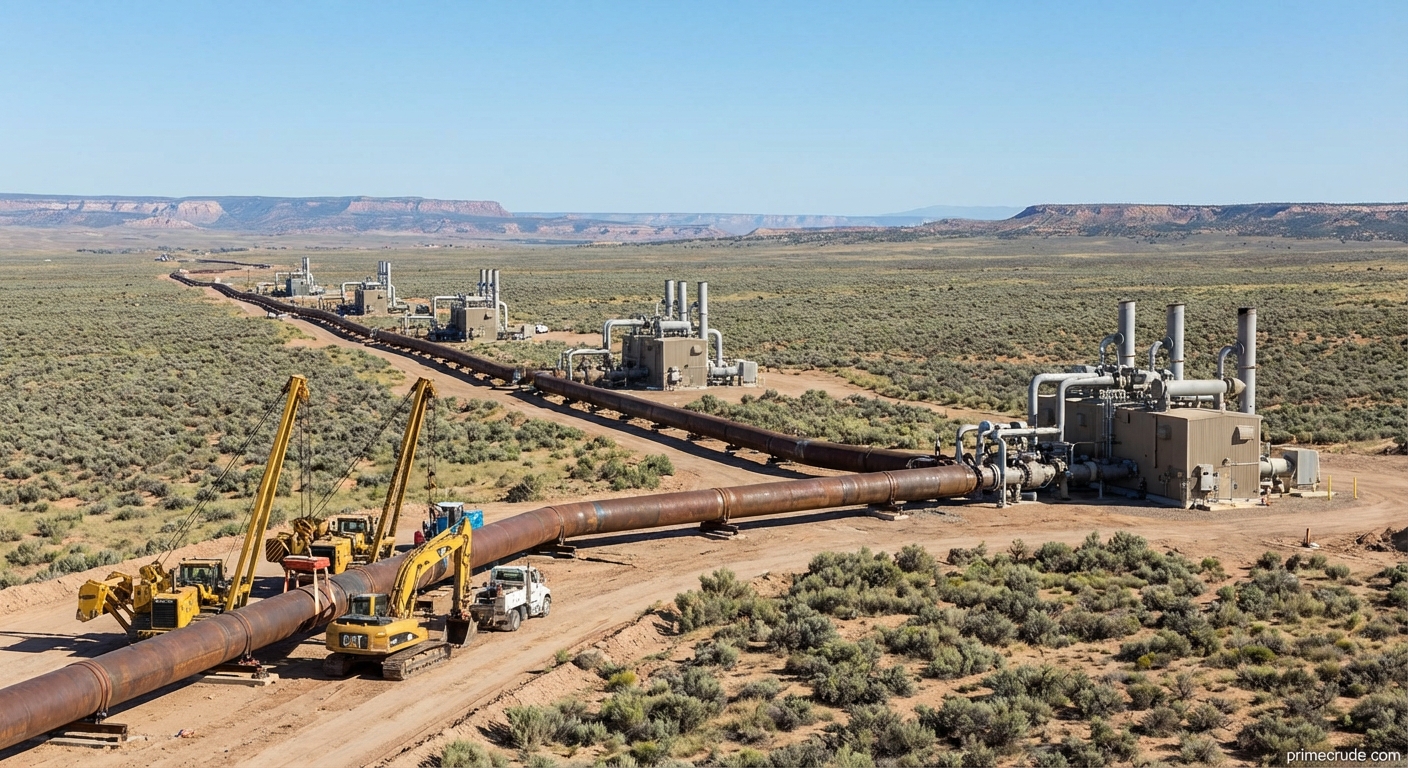
Moving oil through a pipeline requires compression or pumping stations at regular intervals. The pipeline itself is
passive steel pipe, but pumping stations push the oil forward against friction losses. A typical crude pipeline
might include pumping stations every 30-60 miles, with each station adding pressure to move the oil to the next.
Different crude types flow at different rates. Light, low-viscosity oils flow easily. Heavy crudes and bitumen may
require dilution with lighter hydrocarbons or heating to flow at all. Pipeline operators carefully manage batch
separations when different crude types move sequentially through the same line.
The Permian Basin Pipeline Build-Out
No region has seen more dramatic pipeline expansion than the Permian Basin of West Texas and southeastern New
Mexico. As shale oil production exploded after 2015, existing pipelines proved inadequate. Crude oil backed up in
the basin, creating severe price discounts relative to Gulf Coast markets. At the worst, Permian crude sold for
$15-20 less than comparable grades at the coast.
This price differential signaled opportunity for pipeline developers. Between 2019 and 2023, multiple major
pipelines and expansions added over 4 million barrels per day of takeaway capacity from the Permian to Gulf Coast
destinations. Gray Oak, EPIC, Cactus II, and Wink-to-Webster were among the most significant additions.
Current Capacity Situation
The Permian pipeline build-out largely achieved its goal. By 2024, takeaway capacity substantially exceeded
production, eliminating the severe price discounts. The differential between Midland and Houston prices now
typically runs only $1-2 per barrel, reflecting transportation costs rather than capacity constraints.
Some observers question whether the industry overbuilt. Pipelines compete for volumes that grow more slowly than
expected. However, having excess capacity provides flexibility for future production growth and competes down
transportation costs for producers. The market will eventually absorb available capacity as production expands.
The Keystone System and Canadian Oil Access
Canada’s oil sands in Alberta contain one of the world’s largest petroleum deposits, with over 160 billion barrels
of proven reserves. However, the landlocked location requires pipelines to reach either U.S. refineries or Canadian
coastal export terminals. The Keystone pipeline system has been central to this access, and its expansion became one
of the most contentious energy projects in recent memory.
The existing Keystone pipeline, completed in 2010, carries approximately 590,000 barrels per day from Alberta to
U.S. Midwest refineries and Cushing, Oklahoma. This workhorse system operates reliably and represents critical
infrastructure for both Canadian producers and American refiners configured for heavy crude processing.
Keystone XL: The Project That Wasn’t
The proposed Keystone XL extension would have added over 800,000 barrels per day of capacity on a shorter, more
direct route to the Gulf Coast. The project became a symbol of the clash between energy development and
environmental activism. Multiple presidential decisions, extending across three administrations, alternatively
approved, rejected, and finally canceled the project.
President Biden’s cancellation of the Keystone XL permit on his first day in office in 2021 effectively ended the
project after over a decade of controversy. Canadian producer TC Energy abandoned the project, writing off billions
in invested capital. The saga demonstrated how politically contentious major pipeline projects have become.
Trans Mountain Expansion: Canada’s Coastal Access
With U.S. pipeline options constrained, Canada pursued an alternative route: expanding the Trans Mountain pipeline
from Alberta to British Columbia’s Pacific coast. The expanded system, which entered service in 2024, adds over
590,000 barrels per day of capacity, roughly tripling the original system’s throughput.
The project faced intense opposition from environmental groups and some Indigenous communities. Legal challenges
delayed construction repeatedly. Cost overruns ballooned the project budget from an initial $5.4 billion to over $30
billion. The federal Canadian government purchased the project from Kinder Morgan in 2018 when the private company
concluded the regulatory risk was unmanageable.
Strategic Significance for Canada
Despite its troubled construction, Trans Mountain holds strategic importance for Canadian energy. Pacific coast
access opens Asian markets for Canadian crude, reducing dependence on American buyers who have historically captured
most Canadian exports. The ability to ship to multiple markets improves pricing for Canadian producers.
The expanded pipeline also provides redundancy in Canada’s export infrastructure. Previous pipeline constraints left
Canadian crude selling at steep discounts to international benchmarks. Multiple export routes help prevent the
recurrence of such disadvantageous pricing situations.
The Dakota Access Pipeline Controversy
The Dakota Access Pipeline (DAPL), completed in 2017, carries Bakken crude oil from North Dakota to an
interconnection in Illinois where it enters the larger pipeline network. The 1,172-mile pipeline can transport over
750,000 barrels per day, providing crucial market access for Bakken producers otherwise constrained by distance from
major consuming regions.
DAPL’s construction generated extensive protests, particularly near the Standing Rock Sioux reservation. Opponents
argued the pipeline threatened water supplies and crossed lands of cultural significance. Protest camps, legal
challenges, and intense media coverage made DAPL a nationally prominent controversy.
Ongoing Legal and Regulatory Challenges
Despite completion and years of operation, DAPL continues facing legal challenges. Courts have ordered additional
environmental review of the Missouri River crossing, though the pipeline remains operational during review. The
outcome could require rerouting or additional mitigation measures.
DAPL’s experience illustrates the ongoing legal vulnerability of pipeline projects. Even after billions of dollars
in construction, completed infrastructure can face years of litigation. This uncertainty adds costs and discourages
investment in new pipeline capacity, contributing to the infrastructure constraints that periodically develop.
Colonial Pipeline: The East Coast Lifeline
Not all major pipelines carry crude oil. The Colonial Pipeline, the largest refined products pipeline in the United
States, carries gasoline, diesel, and jet fuel from Gulf Coast refineries to markets throughout the Eastern
Seaboard. Over 100 million gallons flow daily through this single system, supplying approximately 45% of the fuel
consumed in the region it serves.
Colonial’s importance became dramatically apparent in May 2021 when a ransomware attack forced the pipeline offline
for several days. Panic buying and actual fuel shortages developed across southeastern states. Some gas stations ran
completely out of fuel. The incident demonstrated modern infrastructure’s vulnerability to cyberattacks.
Security Improvements Post-Attack
The ransomware incident prompted significant security upgrades throughout the pipeline industry. Colonial and other
operators enhanced cybersecurity defenses and protocols. Federal regulators issued new cybersecurity requirements
for critical pipeline infrastructure. The response showed that infrastructure protection has become as important as
physical construction.
Nevertheless, the Colonial episode revealed structural vulnerability in East Coast fuel supply. Alternative delivery
methods, primarily by tanker and barge, exist but cannot fully substitute for Colonial’s volume. True supply
security for the region requires both protecting Colonial and developing additional capacity.
Gulf Coast Export Infrastructure
The Gulf Coast has transformed from primarily an import region to a major petroleum export hub. This transformation
required not just production and refining capacity but also pipelines connecting production areas to deep-water
export terminals. Multiple infrastructure projects have enabled the U.S. to become one of the world’s largest crude
oil exporters.
The Corpus Christi area in South Texas has emerged as a primary export hub. New port facilities can load the largest
tankers that can transit the expanded Panama Canal. Pipelines from the Permian Basin and Eagle Ford deliver crude to
these facilities for shipment to Europe and Asia.
Very Large Crude Carrier Access
A current focus of infrastructure development is enabling fully-loaded Very Large Crude Carriers (VLCCs) to load at
U.S. ports. These massive tankers carry 2 million barrels each and provide the most economical transport for
long-distance crude exports. However, U.S. ports traditionally lacked the depth for fully-loaded VLCCs.
Several projects have addressed this limitation. Offshore loading platforms allow VLCCs to load in deep water
without navigating shallow ports. Port deepening projects at existing facilities provide onshore alternatives. This
developing infrastructure positions the U.S. to compete more effectively in global crude markets.
Natural Gas Pipeline Expansion
While crude oil pipelines receive most attention, natural gas pipeline expansion has been equally dramatic. Shale
production generated massive gas volumes, particularly in the Appalachian Basin (Marcellus and Utica shales), that
required new takeaway capacity. Multiple major gas pipelines have entered service, redirecting gas flows across the
continent.
The Appalachian Basin alone has added over 25 billion cubic feet per day of pipeline takeaway capacity since 2015.
Mountain Valley Pipeline, under lengthy development, exemplifies both the demand for additional capacity and the
difficulty of obtaining permits through environmentally sensitive areas.
LNG Export Pipeline Connections
Natural gas pipelines feeding LNG export facilities have become critical infrastructure. These facilities liquefying
gas for international shipment require reliable pipeline supply. Multiple new or expanded pipelines serve facilities
on the Gulf Coast, transferring pipeline gas to tankers bound for Europe, Asia, and South America.
The connection between domestic gas production, pipeline infrastructure, and LNG exports positions American natural
gas as a global commodity. What was once a regional market now participates in international trade, with pipeline
capacity determining how much gas can reach export facilities.
Regulatory and Environmental Challenges
Building new pipeline capacity in North America has become increasingly difficult due to regulatory requirements and
legal challenges. Environmental reviews under laws like the National Environmental Policy Act (NEPA) can take years.
Permit challenges by opponents further extend timelines. The uncertainty discourages investment and extends
infrastructure constraints.
The Federal Energy Regulatory Commission (FERC) oversees interstate natural gas pipelines, while crude oil pipelines
face a more fragmented regulatory landscape. State and local permits often prove more contentious than federal
approvals. Any segment of a pipeline route can become a chokepoint if permits are denied or delayed.
Indigenous Consultation Requirements
Pipelines crossing Indigenous lands or affecting traditional territories face specific consultation requirements.
These processes, when properly conducted, can identify and resolve concerns before construction. When inadequate,
they generate legal challenges that can halt projects for years.
Recent court decisions have strengthened consultation requirements, requiring more thorough engagement before
permits are issued. Pipeline developers increasingly invest in relationship-building with affected Indigenous
communities, recognizing that opposition can be more costly than proactive engagement.
Economic Impact of Pipeline Infrastructure
Adequate pipeline capacity matters enormously to producers and consumers alike. When capacity is tight, producers
receive lower prices for their crude as discounts develop versus pipeline-accessible markets. When capacity is
ample, producers capture prices closer to international benchmarks.
The Permian Basin situation perfectly illustrated these economics. During the 2018-2019 bottleneck, producers left
significant money on the table due to insufficient takeaway capacity. The subsequent pipeline build-out captured
that value, benefiting producers, royalty owners, and state tax revenues.
Jobs and Local Economic Benefits
Pipeline construction creates temporary but well-paying jobs in often rural areas. Welders, equipment operators, and
support workers earn substantial wages during multi-year construction periods. Local businesses benefit from worker
spending. Property tax revenues from completed pipelines provide ongoing fiscal benefits to states and counties.
These economic benefits create political support for pipeline projects in many regions, counterbalancing opposition
from environmental groups. Rural communities that benefit from pipeline construction and operations often become
advocates for continued development.
The Future of Pipeline Development
New major pipeline developments face an uncertain future. Regulatory and legal obstacles have increased costs and
timelines. The energy transition raises questions about long-term petroleum demand. Investors and pipeline companies
increasingly hesitate to commit billions to projects that might not earn returns before demand declines.
Nevertheless, infrastructure needs persist. Existing pipelines age and require replacement or significant
refurbishment. Changing production patterns shift demand for capacity between regions. Export growth requires
continued development of terminal access. The pipeline industry will remain active even if fewer giant greenfield
projects proceed.
Carbon Capture Pipeline Opportunities
A potential new use for pipeline infrastructure is transporting captured carbon dioxide to storage sites. Several
proposed projects would build CO2 pipeline networks connecting industrial sources to underground storage in depleted
oil fields or saline aquifers. These projects could extend pipeline industry relevance into the low-carbon future.
Whether CO2 pipelines achieve significant scale depends on policy support, carbon pricing, and technology
development. Some existing pipeline corridors might be repurposed for CO2 transport, leveraging established
rights-of-way and community relationships.
Conclusion
The major oil pipeline systems of North America form an essential but often invisible infrastructure enabling modern
energy systems. From the Permian Basin’s takeaway capacity to Trans Mountain’s Pacific access, from Colonial
Pipeline’s products delivery to the Gulf Coast’s export terminals, these systems determine which oil reaches which
markets and at what price.
Building and maintaining this infrastructure has become increasingly challenging. Regulatory requirements, legal
challenges, and public opposition have extended timelines and increased costs for new capacity. The energy
transition adds uncertainty about long-term returns on infrastructure investment.
Despite these challenges, pipelines will remain central to North American energy for decades. Existing systems carry
the crude that powers transportation and industry today. New capacity, where it can be developed, will enable
production growth and market access. The infrastructure decisions made today will shape North American energy
patterns for the remainder of the petroleum era.
The pipelines beneath our feet represent billions of dollars of investment and decades of engineering,
serving as the essential but unseen infrastructure of modern energy.
About the Author